
Information pack for public contributors
1 Welcome to The Open University
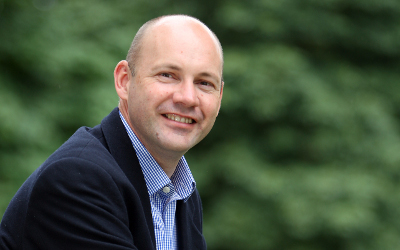
We are delighted that you can contribute to our mission of bringing education and research with public value across all four nations of the UK and beyond. We’re proud of our past and excited about the future, and I hope you enjoy making your contributions.
Mark Brandon Pro-Vice-Chancellor for Research and Innovation
The Open University was established in 1969 with a mission to make learning accessible to all. We are now a global leader in higher education and have already helped more than 2 million students to realise their ambitions.
Our headquarters are at Walton Hall in Milton Keynes and we also have nation offices in Edinburgh, Cardiff and Belfast.
However, much of our teaching and research happens online. This means that we can reach every adult in the United Kingdom and many more across the world.
Our success depends on our staff, students – and you, our public contributors.
2 The importance of public contributors
Public contributors are members of the public who have knowledge, skills or insights from their personal lives and experiences that are of great value to include in the education curriculum and our research.
Student nurses, for example, gain invaluable skills if they can learn directly from people who have personal experience of receiving nursing care. Research into the impact of climate change on food production will be greatly strengthened by the involvement of public contributors from farming communities.
You may be wondering ‘Why me?’ or questioning whether your knowledge and insights are really that important. The better question, perhaps, is why not you? If you can share your experiences, knowledge and ideas, then you are as qualified as anyone to be a public contributor at The Open University.
Your involvement in education and research will significantly help students connect theory to real-life situations, making their learning more relevant, respectful and responsive to the people and communities that our graduates, educators and researchers work with. It also ensures that we are asking the right research questions and doing research that is more likely to make a difference to people’s lives. By sharing your expertise, you are making a very real contribution to academic life.
Why do I hear people talking about PPIE?
Unfortunately, universities are full of jargon. If you are a public contributor – especially if you are in health, social work or social care – you will hear people talking about PPIE. There’s a list at the end of this information pack of some of the terms that you may find it helpful to know.
PPIE stands for ‘Patient and Public Involvement and Engagement’.
It means working with members of the public on things like research or sharing knowledge. Sometimes it also includes helping to design or teach courses.
PPIE means that public contributors work as partners. They share ideas and decisions with researchers rather than just being told what to do.
It’s different from normal research and teaching activities where things are done to, for or about people. In PPIE, the public is part of the team.
2.1 How The Open University benefits from public contributors’ involvement
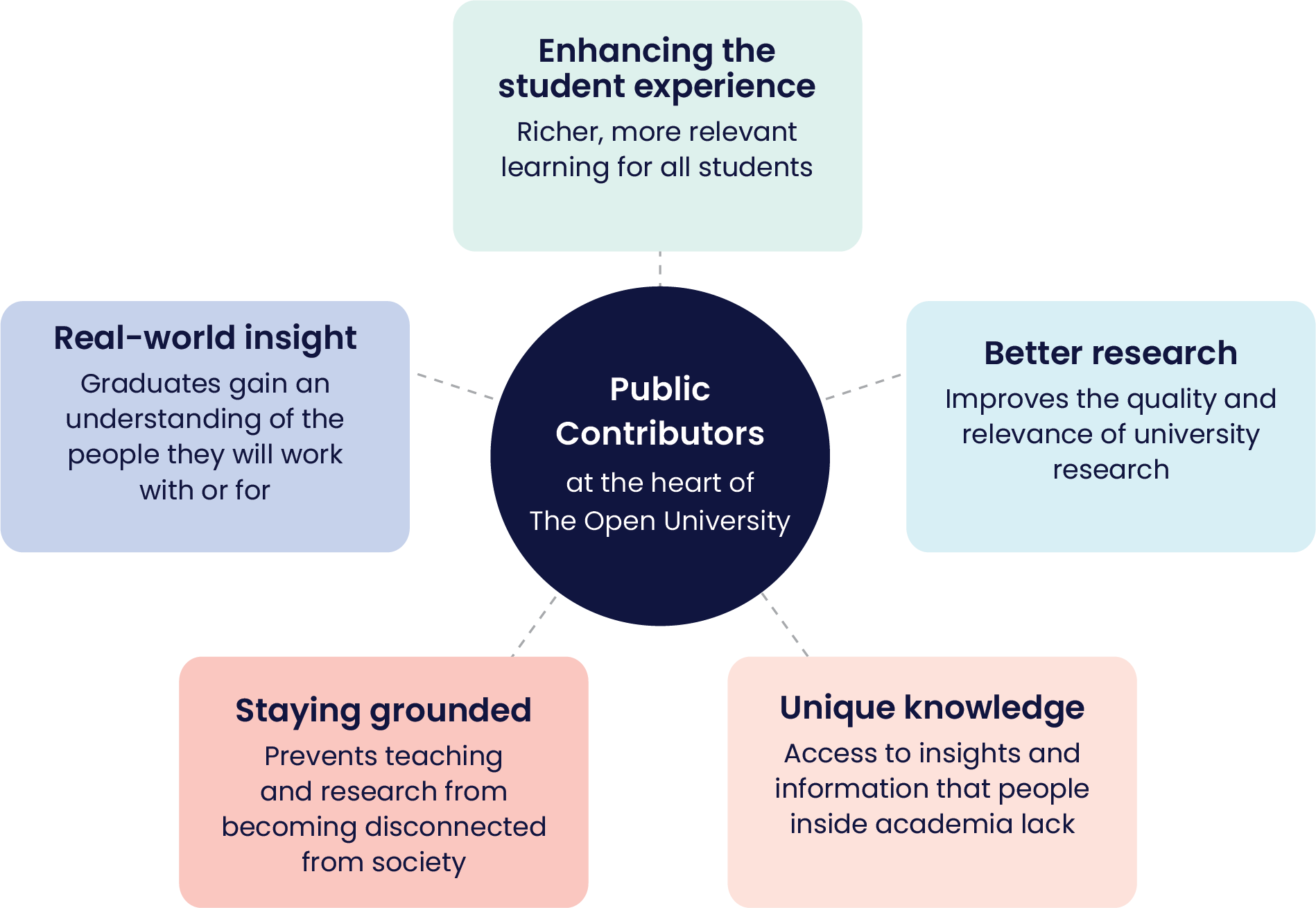
The Open University could not deliver high-quality student experiences, education or research without the involvement of public contributors. Key benefits to the University include:
- enhancing the student experience
- improving the quality and relevance of research
- helping students to understand the impact of power relationships, for example, when someone tells their story and is not believed because of prejudice
- creating spaces where equality, diversity and access can be more fully explored and considered
- preventing teaching or research becoming disconnected from the world outside of academia
- providing access to insights, information and knowledge that people in the University don’t have
- encouraging empathy and the development of advocacy skills.
2.2 How public contributors say they benefit from involvement
We are grateful to the public contributors who took part in conversations and interviews as part of creating this information pack. These are their thoughts about how they have benefited from contributing to our research or teaching:
This is a chance to make a difference.
You will be valued for who you are and not just for what you know.
I went from feeling "I'm not qualified" to knowing "My input matters".
They recognise your skills and that your view and input is valid.
Getting involved breaks down barriers and can help you see things differently. It can shape your future as much as it shapes the future of the students and staff.
We share and learn. We all have different experiences, knowledge and backgrounds.
Being around other people reduced my bitterness at how I’d been treated in the past.
You can get involved in ways that fit with your skills, interests and priorities.
Many public contributors draw on personal or lived experiences. Sharing these can be rewarding, but it can also be emotionally draining. The University encourages public contributors to set personal boundaries so that they only share what they are comfortable discussing.
2.3 Does being a public contributor take over your life?
It is difficult to give a general rule about the commitment involved as a public contributor because each project and role is unique. Your contact person at The Open University can tell you all the practical details, including the time commitment, before you decide whether you want to accept a particular public contributor role.
For some people, being a public contributor does become a main part of their life and identity. For many more, it is something that they do only occasionally.
Some people contribute to one Open University project because of a special interest and that is the limit of their involvement; others might become public contributors at several universities and be involved in many projects. You are always in control of whether you look for and accept opportunities to be a public contributor.
3 Responsibilities
Public contributors and The Open University have a two-way relationship that both parties give and receive from.
Your contact person at The Open University will explain the type of relationship that is suitable for your role and activities. For example, you might be offered a role as a volunteer or on a paid contract.
Whatever your role, everyone involved needs to commit to a set of values and ways of working that are:
- Ethical - principled decisions and conduct.
- Fair - equitable treatment and opportunities.
- Transparent - open and honest communication.
![A three-circle Venn diagram. Circle one is Ethical. Principled decisions and conduct. Circle two is Fair. Equitable treatment and opportunities. Circle three is Transparent. Open and honest communication.]](/sites/research.open.ac.uk/files/images/article/ppie-values-venn-diagram.jpg)
3.1 The Open University’s responsibilities to you
We will:
- give you enough information about a role for you to make an informed choice about whether to accept it
- communicate with you about any changes to plans
- treat you with respect as a valued contributor
- keep your personal information secure and tell you how we are using it
- be alert for signs of unconscious bias, discrimination or unethical behaviour, and take steps to prevent it
- make sure you understand your role and where you fit in if you are joining an existing group or panel
- make sure you know which expenses, incentives or fees, if any, you can claim, and how this can be done
- discuss any access or support needs that you may have, and whether these can be met.
3.2 Your responsibilities to The Open University
You will:
- be honest be yourself
- keep us up to date on anything that may affect your ability to contribute
- respect confidentiality
- inform the team if you are unable to attend meetings or activities
- work collaboratively with staff and other contributors
- tell us about any conflicts of interest.
4 Practical information
4.1 Research ethics
It is very important to The Open University that all our work is done ethically. This includes making sure that public contributors are only asked to do things that it is ethically right to ask them to do. The Research Ethics team can advise research and teaching staff on these matters.
This section only applies if you are a public contributor for a research project.
A public contributor may help to design interview questions or advise on a research project. By doing this, they would be helping to shape the research rather than taking part in it as a participant.
Sometimes the Research Ethics team will decide that the public contributors need to read an information sheet and sign an informed consent form, just like research participants would do.
This does not mean you are a research participant – you are still a public contributor! It is simply a way to make sure that The Open University knows that you have thought carefully about your role before you agree to take part.
4.2 Public acknowledgement of your work
If you are involved in a teaching activity, this may include creating new course materials. Some course materials list the authors, co-creators and contributors.
If you are involved in research, there may be opportunities to co-author reports or academic papers. Your contributions may be acknowledged in reports, publications and other research outputs.
The Open University needs to ask your permission before we make any information about you public. This means that your contact person at The Open University will need to ask you to sign a form before we can publish your name or something that you said or did.
Your contact person can help you think about reasons for and against the publication of your name or details of things you have said or done. We will keep a record of your decision and follow your wishes.
4.3 Money
Your contact person will explain what (if any) expenses and fees you can claim from The Open University as part of your public contributor role.
If you are unsure what you can claim for, please ask your contact person for clarification before incurring any cost or agreeing to do an activity.
The expenses and fees you can claim will depend on:
- the type of activity you have been asked to do
- how much (if anything) the project you are invited to take part in has a budget to fund expenses and/or fees to public contributors.
Expenses
Your contact person will tell you what expenses you can claim, if any.
They will give you an expenses claim form (Word, 40 KB), show you how to fill it in and tell you where to send it.
It can take up to six weeks for expenses to be reimbursed, so your contact person may be able to arrange for items such as accommodation and train travel to be purchased for you directly by the University.
Access costs
Please talk to your contact person about any access costs before you agree to a role. Examples of access costs might include:
- replacement childcare or adult care
- a support worker
- a British Sign Language interpreter.
Contributing as a volunteer
Many public contributors are volunteers. This means they are not paid for their time. They may, however, be offered a ‘thank-you’ voucher. Please be aware that the voucher may affect your benefits and tax position. If this means you would not want a ‘thank-you’ voucher, you should tell your contact person.
Being paid a fee
Some public contributors may be offered a fee for their time. This is more likely when they are using their lived experience to deliver research or teaching activities alongside staff. Tax and employment law are complicated. If you are offered a fee, The Open University will tell you if it has to deduct tax and National Insurance before payment or if you will need to declare this income to HMRC yourself. The Open University will decide this based on HMRC rules. Sometimes The Open University makes a donation to an organisation or charity rather than paying the public contributor directly.
You can get more information about how payments from The Open University may affect your benefits and tax from the NIHR website.
5 Words you may hear
Universities use words that are not part of everyday life. Here are some of the common words and terms you may hear and what they mean:
Human Research Ethics Committee (HREC)
The Open University’s HREC provides a mechanism for assuring the ethical integrity of research carried out by staff and directly registered postgraduate research students. An ethics review by HREC is required for research projects that involve collecting data or biological samples from human participants.
National Institute for Health and Care Research (NIHR)
The NIHR is funded by the Department of Health and Social Care to improve the health and wealth of the nation through research. Working in partnership with the NHS, universities, local government, other research funders, patients and the public, it funds, enables and delivers world-leading health and social care research that improves people’s health and wellbeing and promotes economic growth.
Patient and Public Involvement and Engagement (PPIE)
PPIE is embedded across The Open University in our research, teaching and learning, knowledge exchange and impact activities. For this guidance, we define PPIE as activities that are carried out ‘with’ or ‘by’ members of the public (‘public contributors’). PPIE is also used in co-production and co-design, where the public work together and share power and responsibilities with researchers and stakeholders from the start to the end of a project. PPIE is different from research participation, which is research that is done ‘to’, ‘for’ or ‘about’ patients and the public.
Public contributor
Public contributors are members of the public engaged in PPIE activities. They may also be known as service user and carer representatives, patient representatives, lay experts, co-researchers, experts by experience, lived experience consultants, or similar titles.
Co-creation, co-production and co-design
You might hear people talking about co-creation, co-production or co-design and, at The Open University, we do all three! These terms are closely related and are often used interchangeably.
Co-creation
Academics and members of the public work together in a way that gives power to people who usually get ignored or treated unfairly.
Co-production
Academics, other professionals and people who use public services work together so that research, teaching and public services are more effective.
Co-design
The goal of co-design is to design better research, teaching or services by involving people who use the services in designing them. It often involves workshops and testing early versions before rolling something out fully.
Many people at The Open University now use the term ‘co’, which covers all three approaches and is defined as follows: ‘Co’ is an approach to research where the user or beneficiary of the research is actively involved in its creation.
Research Excellence Framework (REF)
The REF is the assessment exercise by which the higher education funding bodies of the four nations, led by Research England, evaluate the quality of research across the UK higher education sector at subject level.
Citizen science
Citizen science is a growing trend in which the public are involved in different types of collaboration with scientists. The growth of this activity has consequences for data collection and data analysis, and how science is conducted. It also has a potential impact on what and how citizen scientists learn about science when engaged in such activities.
Community researchers
Community-based research is a collaborative approach to investigation that involves community members, academics and other stakeholders working together to gather and utilise research data, focusing on the strengths and priorities of the community to enhance health and social equity.
Community researchers are people from the community who lead or contribute to research activities.
With thanks to:
Anne Collis, lead author
Laura A, co-author
Raj Mehta, co-author
and other public contributor co-authors from within and beyond The Open University
Note:
Public contributors are known in some departments as service user and carer representatives, patient representatives, lay experts, co-researchers, experts by experience, lived experience consultants, or similar titles.
Document downloads
View or download the information pack in an alternative format.


Explore

Undergraduate
Postgraduate
Policy
-
Follow us on Social media
-


