Research Excellence Framework 2029 Code of Practice
1 Introduction
1.1 The Research Excellence Framework (REF) is an assessment of research in UK higher education institutions carried out by the four national funding bodies (see note 1) every several years, based on the evidence generated over that period. The outcome of the REF informs the allocation of quality-related (QR) research funding to The Open University (OU). It contributes to the accountability for public funding of academic research and demonstrates the benefits of public investment in research and the resulting impact of that research beyond the sector.
1.2 Institutions submitting into the REF are required to develop, have approved by the funding body, and adhere to an institutional REF 2029 Code of Practice (CoP). The CoP sets a minimum standard for participation and consists of a set of guidelines and technical procedures relating to key decisions (delegated to the OU) about its submission. The key decisions concern:
(i) identifying Teaching and Research (T/R) staff contracts (aka roles) that have ‘Significant Responsibility for Research’ (SRR) (see note 2) [Part 2]
(ii) identifying ‘Research Independence’ (RI) (see note 3) in Research-only (R-only) roles [Part 3]
(iii) the allocating of eligible roles to a UOA [Part 4]
(iv) the allocation of eligible outputs to Unit of Assessment’s (UOA)(s), and (v) the selection of outputs from each UOA research output pool for submission into REF [Part 5].
1.3 This CoP is founded on the guidance and requirements within the draft REF Guidance on Submissions (GOS) and the Equality Impact Assessment (EIA) guidance.
1.4 The CoP is not a staff management or research time allocation policy. Its purpose and currency is purely to guide and transparently articulate the institutional processes that will be followed to develop the REF 2029 submission. The CoP has no relationship with, or bearing on, the allocation of time for research to staff, which is (and will continue to be) determined by existing University Academic Terms and Conditions and Faculty/local workload management processes and practices.
1.5 As a four-nation University with research capacity mostly in England, the OU submits a single REF submission to Research England (RE). Approval of our CoP will be informed, as appropriate, by the REF 2029 People and Diversity Advisory Panel (PDAP) and/or the Research Diversity Advisory Panel (RDAP) prior to approval and implementation.
1.6 The REF seeks through the CoP (to go beyond procedural and legislative compliance) to support the principles of robustness, transparency, equity and inclusion within the key decisions made by the OU that shape its REF submission. The approaches to advance these principles are covered separately in the following sections. It aims to make the procedures shaping the submission clear, transparent, fair, inclusive and consistent across the OU and will aid it in promoting equality and diversity (E&D), complying with legislation and avoiding discrimination (including unconscious bias), when preparing its submission.
1.7 In line with the OU’s Equality Scheme 2022-2026 (internal link only) objectives (see below) and the UK Equality Act 2010 , the University seeks to ensure that its submission is inclusive and representative of the eligible work of in-scope staff and by extension, the research undertaken within the submitting UOA during the REF period.
How this CoP supports the principles of:
Robustness
1.8 The governance and management for the development and sign-off of the REF submission is described below. The Pro-Vice-Chancellor (Research and Innovation) (PVC-R&I) is the sponsor and senior officer of the OU accountable for the University’s REF processes and submission, with input from Executive Deans, Associate Deans (Research) (ADR or their equivalent), the Research and Knowledge Exchange Board (RKEB; formerly Research Board) and UOA Panel Chairs.
1.9 The project management and quality assurance of the REF submission will be overseen by the Director of Research & Innovation Services (DRIS), as ‘senior accountable executive’. This includes ensuring that adequate resource is made available for the development of the submission, monitoring progress against key milestones, managing any risks and issues identified. They are responsible for escalating significant risks and issues to the PVC-R&I.
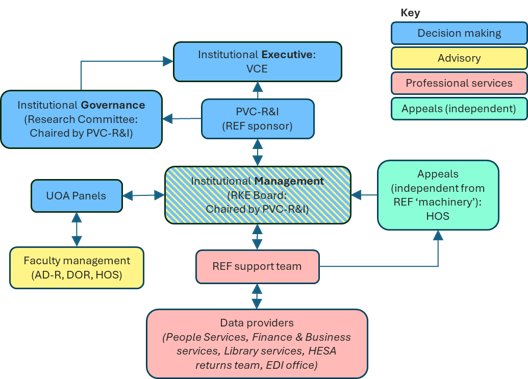
1.10 Operational responsibility is delegated to the Head of Culture and Impact within the Research and Innovation Services (RIS) unit. They are responsible for the work of the REF Support Team overall. Reporting to this person is the Senior Manager Research Strategy who is the University’s REF Manager and supervises the REF Support Team.
1.11 The central REF Support Team, drawn from different professional service areas, provides administrative support, including:
- answering queries, providing guidance and technical advice
- providing data and reports
- organisation of equality training for RKEB, UOA Panels and others
- EIA: including collation and analysis of REF equality monitoring data as well as the publication of the findings and actions
- providing guidance to ensure clear records of UOA Panel processes and decisions are kept.
1.12 The REF Support Team works closely with ‘Data Providers’, including People Services (PS); Governance, Compliance and Legal Services (Returns team); Library Services; Finance and Business Services (FBS); Equality, Diversity and Inclusion (EDI) office; and Communications.
Formal committees and advisory bodies
1.13 The Vice-Chancellor’s Executive (VCE) has overall institutional management responsibility for the REF submission and will make recommendations to Research Committee.
1.14 The University’s Research Committee (RC) has governance responsibility. It approves:
(i) the University REF strategy
(ii) the CoP
(iii) the University response to the survey of submission intentions (SSI) and
(iv) the final REF submission and associated EIA. Its terms of reference and membership are appended.
1.15 The RKEB, chaired by the PVC-R&I, is the institutional management group advising the PVC-R&I on the effective implementation of the institutional Research Plan (in which a successful REF outcome is a key deliverable). Its terms of reference and membership are appended. Its role here is to advise on institutional management decisions, advise on the development, content and readiness and provide feedback to the UOA Panels to inform their preparations for the submission. Due to the breadth of its remit beyond REF, it is envisaged that additional members will be co-opted for key REF-related decisions later in this REF cycle (to ensure appropriate experience, breadth and representation).
1.16 The RKEB may call upon additional expertise (upon PVC-R&I approval) where necessary. Individuals will be selected on the basis of relevant expertise and seniority in the field, which must include:
- a research CV of world-leading/internationally excellent quality
- high-level peer review experience
- a high degree of familiarity with REF procedures and requirements.
1.17 Where individuals external to the OU are involved in the review phase of the submission, they will receive an equality briefing and be required to adhere to this CoP including data protection and confidentiality requirements. They will sign a contract stipulating the need for confidentiality and submit their findings in writing.
1.18 The UOA Panels are responsible for coordinating and developing the UOA submission. They will be required to:
(i) adhere to this CoP; the UOA Terms of Reference (appended) and the REF data protection plan
(ii) keep clear records of related processes and decisions
(iii) undertake relevant E&D training.
RKEB will approve the membership of UOA panels, ensuring for appropriate representation of sub-disciplines, research teams, structures and EDI. The UOA Panel terms of reference (appended) sets out the purpose, membership and mode of operation, giving flexibility to each UOA Panel to be optimised to reflect the complexity, size and breadth of their UOA. As research leaders, the membership gives good coverage of research management responsibilities in the formation and delivery of the local research priorities and strategies as well as internal/external collaborations. A list of UOA panel members will be available to staff.
1.19 The UOA Panel Chair is the main contact point between the UOA Panel and the REF Support Team/RKEB. They will manage activities associated with the preparation of the UOA’s submission, in consultation with other senior management roles (Heads of School (HOS), ADRs, Directors of Research, Executive Deans). UOAs that are larger or straddle Faculties/Schools may have co-chairs or delegate specific responsibilities to sub-profile leads, but the Chair retains overall responsibility for the UOA submission. The Faculty ADRs will endorse UOA Panel Chair appointments (including changes) to the PVC-R&I for approval.
1.20 The final configuration of UOAs for submission will be approved by RC (est. October 2026) and reported through the HESA 2025/26 staff return (driving the two-year averaged ‘volume measure’ for each UOA).
1.21 Appeals from individuals will be considered by the respective HOS (reflecting the REF guidance that appeals be independent of the original decisions and draw on existing mechanisms/structures) – see para 2.15.
Transparency
1.22 This CoP is for all staff associated with REF preparations and the submission. Those with REF management responsibilities must act upon it.
1.23 In contrast to previous research assessments, the move to an annual ‘volume measure’ encourages procedures sensitive to compound burden on individuals. This CoP has been developed prior to the funding bodies publishing the full and final guidance and rules on REF. Changes to this CoP resulting from updates to the guidance and rules will be considered on an individual basis in good faith and may warrant consultation, communication, refreshed EIA and/or reapproval by the funding bodies. The OU will adhere to the underpinning principles of robustness, transparency, equity and inclusion. Details of amendments will be outlined on the intranet alongside the current CoP.
1.24 An up-to-date CoP will be published by the OU and publicised internally to in-scope staff (as well as the funding bodies REF website). Faculty Executive Deans (or equivalent; or delegated) are responsible for ensuring that in-scope staff that are absent for an extended period (e.g., due to long-term sick leave/parental leave/secondment) are notified of its availability as well as any significant revisions.
Communication and consultation
1.25 Development of the CoP has been informed by:
(i) consideration by RKEB/RC
(ii) testing through its application in the 2024/25 REF ‘pilot year’ (including the output and impact reviews)
(iii) feedback from staff and representations during internal consultation in Winter 2025/26.
1.26 There has been extensive internal communication and consultation with staff and representatives in developing the CoP across the four nations. Whilst the processes need not be described here, this has included engagement with Faculty academic committees (FACR), EDI Office, University and Colleges Union OU Branch (OUBUCU), staff representative groups/networks and academic communities to ensure that the approaches and processes in the CoP are fair, transparent, inclusive and consistent. The draft approaches (as well as alternatives) were considered in these engagements.
1.27 Engagement has entailed face-to-face meetings, focus groups targeted at different categories of staff, centralised and local communications, as well as more passive communications such as online survey, intranet content and FAQs, and informal drop-in sessions.
1.28 Due to the multi-site location of staff across the four UK nations, nations input in the initial stages was via RC membership and representation through Faculty ADRs. Separate meetings were held with Staff Tutors/regional/nations academics (ST) associated with the Nations offices in Scotland, Wales, Northern Ireland as well as by Faculty.
Equity and inclusion
1.29 Decisions on SRR/RI; allocation of eligible roles to UOAs; output selection; and appeals of SRR/RI fall within the scope of the Public Sector Equality Duty (PSED) and must therefore be assessed for their potential equality impacts. This requires the OU to give due regard when designing and implementing these processes to:
- eliminate unlawful discrimination, harassment and victimisation
- advance equality of opportunity between people who share a protected characteristic and those who do not
- foster good relations between people from different backgrounds.
1.30 The purpose of the EIA is not to direct either the identification of staff with SRR/RI; staff contract attribution to UOAs nor the selection of outputs: its purpose is to identify (during the design phase of the procedures covered in this CoP) equality impacts and mitigations. In developing the approaches the OU is mindful that even where neutral criteria and processes are applied uniformly, they must be assessed to ensure they do not result in unjustified disadvantage/disproportionate impacts for staff with protected characteristics and as such whether alternative credible approaches would materially reduce the risk.
1.31 Furthermore, the EIA should identify and highlight policies or practices that have a positive impact on, or provide opportunities to, advance equality of opportunities and/or eliminate discrimination.
1.32 EIA analysis was initially considered by RKEB during CoP development and by both RKEB/RC during CoP approval (est. Spring 2026) and contains mitigations (through the options chosen) and monitoring (envisaged to be through existing institutional action plans).
1.33 In developing the SRR approaches, analysis was undertaken comparing the cohort of staff on SRR roles against the whole T/R population and similarly, the RI population against the whole R-only population. These analyses were used alongside the emergent CoP by RKEB/RC/UOA Panel Chairs during 2024/25 and on the HESA 2024/25 ‘pilot year’ staff return.
1.34 Of the UOAs submitting, RKEB will consider and approve proposals from UOA Panel Chairs for a unique approach to determine SRR (‘approved UOA’), subject to impacts on representation (para 2.11).
1.35 Arrangements for ensuring that the submitted outputs are representative are covered from para 5.20.
Contextualisation within institutional policies
1.36 Participation in REF is a key deliverable of the OU’s Research Plan (2022-27). As an internal policy setting out technical and procedural detail, the REF CoP sits within a wider University policy environment for research including relevance to EDI and responsible research assessment. These include:
- Research code of practice (which sets the standards that govern research at the OU, as well as the responsibilities of the University and individuals carrying out research, [updated February 2026]
- Research misconduct procedure
- Ethical research statement
- Open and engaging research statement
- Research data management policy
- Open access publication policy
- Research publications policy [effective March 2026]
- Research metrics responsible use statement (as a DORA signatory).
1.37 These link to external commitments that the OU is signatory, including:
- Concordat to support the Career Development of Researchers, and 'HR Excellence in Research' recognition (HREiR)
- Concordat to support Research Integrity (2025)/Research Integrity Statement, and signposted internal/external training resources
- San Francisco Declaration on Research Assessment (DORA)
- Technician Commitment.
1.38 The OU maintains an Equality Scheme (2022 – 2026) (internal link only), superseding the 2016-2020 version that covered REF 2021, that aims to prevent unlawful discrimination, advance equality of opportunity for all, and promote good relations between people with different characteristics.
1.39 Policies, projects and papers submitted to formal committees are required to be assessed for equality implications with the outcomes used to inform decision-making. Staff receive mandatory training with further training available for colleagues who wish to expand on their knowledge. For example, completing Union Black, taking part in the allyship programme or attending events for different awareness months and days.
1.40 The EDI Committee is chaired by the Pro-Vice-Chancellor for EDI and is supported by a specialist EDI office. The OU publishes data annually on the participation and outcomes for staff for the characteristics of age, disability, sex, gender reassignment, race, religion or belief, and sexual orientation as well as data on participation in governance and data on the gender, ethnicity and disability pay gaps.
1.41 The OU is committed to reducing specific inequalities through its institutional equality objectives which were reviewed in 2026 to focus effort and resource in four key areas: Race, Gender, Disability, Neurodiversity and Accessibility and LGBTQIA+ inclusion. The new KPIs and objectives will be detailed in the EDI Strategy 2026–2031. All units feed into the monitoring and reporting for each of the four priority areas. The Council Diversity Policy also includes specific targets for achieving and maintaining diverse leadership of the institution.
1.42 In addition to specific objectives and policies, the OU actively participates in a number of external equality charters and benchmarks. These include the Athena Swan Charter (since 2012); the Race Equality Charter (since 2026); and the Disability Confident scheme (since 2020).
Update on actions since REF 2021
1.43 Since REF 2021, we have retained our institutional bronze award through the Athena Swan Charter, obtained six School-level bronze awards and five silver School-level award. We are currently working on our application for an institutional silver award and further School level awards, including two Professional Service units (Digital Services and Learning and Discovery Services/Partnership Learning). Institutional actions to support women’s research careers since REF 2021 have included projects such as setting up the Academic Promotions Oversight Group, creating the ‘Women’s Development Community’, support for women’s health (such as the menopause policy) and a parental buddy scheme. The OU also has a Women’s network (Women@OU) and participates in the Leadership Foundation for Higher Education Aurora programme. The OU has several minority group networks (internal link only), including the Carers staff network and operates a Carer Passport scheme (since Jan 2024).
1.44 Since REF 2021, the University was awarded the AdvanceHE Race Equality Charter Bronze in February 2026. Seven key priorities were identified in our Race Action Plan, three of which are most pertinent to the REF:
- Priority 2: Improve the cultural climate for racially minoritised staff at the University
- Priority 4: Improve support for Research-only staff and Research students at the University, and
- Priority 5: Improve the racialised diversity and cultural awareness of Associate Lecturers/STs at the University.
1.45 Actions to address findings in the final EIA for REF 2021 include:
- All research policies are co-located under resources relating to the University’s research environment to improve access and coherence. The REF CoP can be accessed here.
- In respect of encouraging disclosure (by staff) of their special category data in staff records: staff population data is reported and published (see above); staff surveys are clear on purpose and vetted by the Staff Survey Project Panel; Data Management Plans are embedded in business practice; use of opportunities (e.g., quantitative analysis used in the EIA of this CoP) are used to advocate disclosure and be transparent in usage.
- To ensure due consideration is given to the potential impacts on different groups of staff: consideration of equality implications is routine when policies are considered by committee for formal approval.
- Where new research policies, guidance and initiatives are developed, consultation with staff is flagged through the EIA process (scaled to the number of people and extent of impact).
- Capacity for equality impact analysis at the University has been strengthened through the formation of the EDI office, and the creation of the PVC EDI role.
2 Identifying roles with Significant Responsibility for Research
Policies and procedures
2.1 Academic contracts undertaking both teaching and research (T/R) are in-scope of SRR identification for REF 2029 purposes. These roles are reported in the annual HESA staff return independent of, and ‘upstream’ of REF. Whilst this translates to Central Academics and STs, some (ineligible) academic roles undertake neither teaching nor research such as senior academic management positions. Similarly ineligible are Teaching-only roles such as Associate Lecturers (AL). Where an individual holds multiple roles, REF and HESA rules treats each role separately.
2.2 The sole purpose of SRR is to estimate the aggregate research capacity (volume) of submitting units, which then drives the number of outputs and impact case studies (ICS) that each UOA requires for submission. It takes no position, and makes no limitation, on the contribution of individuals to UOA submissions (outputs or ICSs) and has no implications for individual staff in terms of their management or research time allocation (see para 2.28).
Important design considerations when developing the SRR and RI approaches
2.3 In developing an optimal approach to determine which T/R roles have SRR and which R-only roles have RI, key contextual changes to the design of REF (from REF 2021) include:
2.3.1 REF 2029 extends (beyond REF 2021) the shift in moving the focus of assessment to that of the aggregate UOA-level. Submitted outputs are no longer associated with submitted staff in the submission (aka ‘decoupled’) and staff are no longer submitted. SRR/RI have moved from a person-entity attribution to contact-entity (the rationale being that a person’s activity is derivative of the purpose of their role).
2.3.2 The sole purpose of SRR/RI is to generate a sum Full Time Equivalent (FTE) at UOA-level (‘volume measure’) that drives the size of the UOA submission. “It is important to note that the volume measure acts as a proxy measure to determine research capacity only. The inclusion of a specific contract in the [volume measure] does not dictate whether an output…[]...can be included in the submission” and thereby “ensures that the scale of the submission is proportionate to its research capacity“. It does not infer or limit the visibility or contribution that an individual can make to the REF (through submitted outputs and ICSs).
2.3.3 In a departure from previous assessments, the eligibility of outputs authored by staff in non-SRR/RI roles are equally eligible as those authored by staff on SRR/RI roles (subject to the same output eligibility criteria and exclusions on the ‘substantive link’). This removes the unintended consequence in previous assessments (on a person’s sense of inclusion, value and negative impact on career progression) as to whether a person was evaluated to have SRR.
2.3.4 Focusing on the research capacity of the UOA in aggregate across a two-year period has the consequence of including roles ending during this window. This has important implications when formulating an SRR approach in terms of fairness and equality for staff on fixed-term contracts (FTC) or terminating roles where:
(i) the person is not available to provide or validate SRR/RI evidence
(ii) local data retention arrangements may have deleted evidence.
Criteria for SRR
2.4 SRR roles are defined by REF as ones that:
(i) have ‘explicit time and resources made available’ (i.e., planned workload allocation),
(ii) ‘engages in independent research’ (e.g., bids for external grants; has access to research leave/sabbaticals; membership of research centres/institutes) and it
(iii) ‘is an expectation of the job role’ (e.g., as stated in yearly objectives; career pathway; job description, not lag indicators).
Criteria must be based on the expectations of the role as a function of employment, not upon what has been delivered. A process to identify SRR ‘that routinely excludes staff who meet most of these indicators would likely be considered inappropriate’.
2.5 Whilst both Central Academic and ST roles have explicit provision for research activity, the Terms and Conditions (T&Cs) (August 2024) differ in terms of the magnitude of provision for research time: 35 research days plus 44 days study leave, (for Central Academic roles) compared to 22 days for study leave (with the HOS discretion to increase to 44) respectively (for ST roles).
- Central academic T&Cs: “at least 20% of their time shall be set aside for research over and above study leave” (35 days minimum) (para 41) plus “study leave on full salary for two months in each year” (44 days, para 43-1) which “is intended to provide facilities for research and other approved academic purposes comparable to those available to members of academic staff in other universities during the long vacation.”
- Staff Tutors T&Cs: zero research days plus “study leave on full salary for two months within each period of two years” (22 days per annum) plus “research leave that may be applied for is normally one month a year” (para 43-2b). The latter is, however, is upon request to the Faculty Executive Dean.
2.6 With reference to the three criteria for SRR, staff are normally expected to be able to undertake independent research where actively doing research (para 2.4 criteria ii). Both the explicit research ‘day quota’ and the magnitude of allocation offers a sensible approach to differentiate roles on criteria ‘i’ and ‘iii’. On this basis, central academic roles are interpreted as having SRR and ST roles are interpreted as not having SRR. The rationale for this approach reflects:
2.6.1 The extent of difference in research expectations. It aligns with the main functions of the roles and is unambiguous and simple to understand.
2.6.2 Output eligibility is not impacted by the SRR/RI status of the authors role. The decoupling of outputs and the absence of submitting names removes the jeopardy on authors in non-SRR roles in terms of visibility or eligibility of their research outputs/impacts for submission (para 2.3.1). The framing of the contribution of STs to the research endeavour within the Schools is anticipated to be narrated in the Strategy, People, and Research Environment (SPRE) sub-profile and Statement of Representation (SoR) and quantitative analysis is expected to evidence the extent to which the submitted outputs (via the ‘substantive link’) were authored by those in non-SRR/RI roles.
2.6.3 With reference to the purpose of the ‘volume measure’ as a proxy of the research capacity of the contributing Units (para 2.3.2), ca.95% of research days reported by Central academic roles/ST roles are reported by the former (and was a comparable value in REF 2021). An alternative approach using individual-level evidence of expectations would not produce a materially different outcome.
2.6.4 The approach enables SRR positions to be established in an easily understood and predictable way.
2.6.5 The approach allows for the SRR position for roles starting/ending in-year (inc. FTC), which often lack workload data/lead indicators, to be established on an equal basis (as roles active throughout the year).
2.6.6 For staff on multiple or sequential roles in the reporting year, it avoids the need to disaggregate evidence between roles. An alternative approach using planned workload data for example (as evidence for criteria ‘i’ of SRR), reports at person, not role entity.
2.6.7 From an equality perspective, the degree of representation of staff with protected characteristics is comparable to the alternative person-level approach (see EIA).
Decision-making and communication
2.7 SRR is derived from academic roles with different T&Cs and therefore entails no additional decision making (with the exception of ‘approved UOA’s – para 2.11).
2.8 Communication of SRR position will be limited to the extent required by REF for the role holder to judge whether to appeal in a particular year contributing to the REF ‘volume measure’. All staff present at the OU at academic year-end who held an in-scope staff contract during the academic year will be informed in writing by either the PVC-R&I/UOA Panel Chair/REF Support team. The indicative roles, process and timings are appended (A1).
Multiple processes
2.9 Where a UOA evidences significantly different disciplinary norms from the University in general, a supplementary approach to identify central academic roles with SRR can be used. Without this accommodation the general approach would materially overestimate the ‘volume measure’/research capacity of the contributing Units(s), thereby placing undue burden on its staff to generate an outsized volume of evidence to REF.
2.10 Initial analysis indicated this option to be potentially relevant for practice-based UOAs (that generally evidence lower research time allocations), but not justifiable for UOAs containing only a small fraction of practice-based staff.
2.11 Where a UOA contains a high-fraction of practice-based central academic roles, the UOA Panel Chair and relevant ADR(s) can seek approval (to be an ‘approved UOA’) from RKEB/RC to apply supplementary criteria relating to those in para 2.4 (e.g., use of planned workload allocations for criteria ‘i’ or criteria ‘ii’ regarding indicators of independent research) to derive a more accurate estimate of UOA research capacity. RKEB/RC approval will be informed by representation analysis; principles of transparency, fairness and proportionality; and a statement from the UOA Panel Chair.
Staff, committees, and training
Roles and responsibilities
2.12 Decisions on SRR are limited to:
- the University approach for SRR (RKEB/RC)
- the interpretation of supplementary SRR evidence (‘approved’ UOA Panels)
- consideration of appeals (relevant HOS).
Training
2.13 Due to the formulaic approach of SRR, there are no decisions makers and hence no SRR-specific training requirements (with the exception of ‘approved’ UOA Panels).
2.14 Beyond those staff already receiving REF-specific training because of being REF decision maker (RKEB, UOA Panels), the relevant HOS of an appellant (see next section) will receive REF-relevant EDI and unconscious bias guidance/training.
Appeals
Grounds for appeal
2.15 Staff can appeal the SRR position for their role and only considered on the grounds of:
(i) procedural irregularities (e.g. not adhering to this CoP)
(ii) where sufficient and auditable evidence to the contrary is presented in respect of the SRR approach (e.g., data quality issues regarding role or employment dates) (para 2.6).
iii. (‘approved’ UOAs only) Interpretation of SRR evidence (from para 2.11).
2.16 Following internal appeal, where individuals consider that the CoP has not been appropriately followed, there is the opportunity to complain in confidence to the funding bodies and this will be signposted on the intranet.
2.17 Given the absence of significant decision making, appeals are expected to be rare and likely based on data errors (note: no appeals were lodged in REF 2021 but some administrative queries were resolved upstream of needing to appeal). In anticipation of queries and appeals, the following is noted:
- Academic roles which are not T/R are likely ineligible (para 2.1).
- The data used is that for the last day of the role in the reported year. This approach aligns with the HESA reporting whereby if a role’s FTE changes in-year or there is promotion in the role, the last position is used for the ‘volume measure’. Accounting for intra-year changes to roles would be immaterial to the UOA ‘volume measure’.
- Individuals changing roles during an academic year (e.g., from Teaching-only to T/R) would be listed for each role in the HESA return, but only the T/R role would be eligible for SRR.
Appeals process
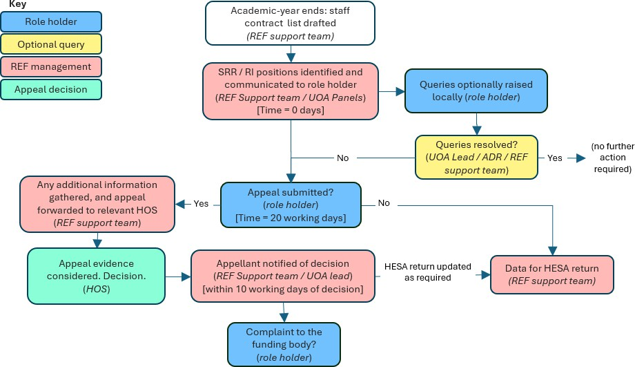
2.18 The appeals process is summarised in Figure 2 below. Concerns by individuals should be raised locally and informally (where possible) in the first instance with the relevant UOA Panel Chair. This may identify simple data/administrative errors that (when corrected) make an appeal unnecessary. Queries received by the REF Support Team from staff in previous REFs generally reflected an unfamiliarity with REF guidance/rules or data quality issues.
2.19 Appeals should be emailed (FAO Strategy Manager) within 20 working days of the SRR position communicated with staff. The email should state (within 250 words) the grounds for appeal (reference para 2.15) in the context of the SRR approach (para 2.6).
2.20 Appeals will be considered independent from the original decision. Where an initial data verification (triggered by the appeal) identifies incorrect records, these will be corrected upon confirmation by the relevant HOS.
Based on both (i) the formulaic nature of SRR outcomes and (ii) historical precedents, it is likely that this will resolve all but exceptional appeals that then require a decision by the relevant HOS. This will consider:
(i) the grounds for appeal (para 2.15)
(ii) data used for the SRR position, and findings from the initial verification.
iii. criteria for SRR (para 2.6). For ‘approved’ UOAs this includes additional SRR evidence (para 2.11) – for which, the following will be considered:
i. the minutes of the Panel decision
ii. associated evidence, and
iii. a response from the UOA Panel Chair to the contents of the appeal and findings from the verification. Due to the involvement of the individual in the production of the evidence and the recommendation to first speak with the UOA Panel Chair, we would expect an appeal on the completeness/accuracy of the evidence to be unlikely but possible.
2.21 The above evidence will also be sent to the appellant. There will be the option for an appellant to request a meeting. Where an appeal overturns the original SRR position, the corresponding HESA staff return will be updated in line with arrangements provided by the REF guidance.
Communication of outcomes
2.22 The appellant will receive the outcome in writing within 10 working days after the process has concluded (copied to the UOA Panel Chair, ADR, HOS, PVC-R&I). It will outline the reasons for the decision.
2.23 The outcome of the appeal will be final as far as the University’s procedures are concerned, however where the appellant considers that the CoP has not been followed, there will be the opportunity to lodge a complaint to REF (para 2.16).
Equality Impact Assessment (EIA)
EIA Integration
2.24 Key design changes over previous assessments have driven the rationale for the approach taken which is credible, transparent and proportionate. These include
(i) not submitting individuals
(ii) the purpose of SRR/RI as an UOA-aggregated proxy for research capacity rather than reflective of the capacity or outcomes from an individual
(iii) the equal eligibility of outputs from authors in non-SRR/RI roles
(iv) the annual basis of determining and reporting SRR/RI.
2.25 The approach was validated by an EIA (appended) (para 1.29). The EIA seeks to identify risks/unequal outcomes and mitigating steps taken.
2.26 In developing the approach to identify roles for which there is an expectation of SRR/RI, the OU has from the outset, considered whether a specific approach is likely to result in material differential impacts. Using the population of current role holders, representation of protected characteristics was considered and modelled from the outset (Research Board April/June 2025) and at key stages in developing and testing the SRR approach. Testing of SRR/RI approaches was through the HESA 2024/25 ‘pilot year’ staff return and validated through the CoP consultation (para 1.25). The allocation of eligible roles to UOAs was tested through the HESA 2024/25 ‘pilot year’ staff return and developed during 2025/26.
2.27 As would be expected in a large population, a minority of Central Academic roles report negligible research time alongside a minority of STs reporting significant research time (Central academic roles: median 78 research days/69 average; STs median 0/average 8). The approach returns a level of error at role-level materially below that of routine (see para 2.4). An alternative approach to consider role-level planned research capacities would make immaterial difference to the ‘volume measure’ (modelled variance of <5 FTE; <0.5% of SRR FTE).
2.28 It is important to restate that the purpose of SRR/RI is to estimate the aggregate research capacity (volume) of submitting units only. It takes no position, and makes no limitation, on the contribution of individuals to UOA submissions and has no implications for individual staff in terms of their management or research time allocation. The CoP is not a staff management or research time allocation policy. The CoP has no relationship with, or bearing on, the allocation of time for research, access to internal funding and support, which is (and will continue to be) determined by existing University Academic T&Cs and Faculty/local workload management processes and practices. The University values the contributions of all academic staff members to the University’s research activities and research environment, irrespective of the SRR/RI position of their role or contribution to the REF submission. This is consistent with the Funding Bodies framing of REF 2029 and its design (listed in para 2.3 above). It is also consistent with our commitments as a DORA signatory regarding appropriate use of research metrics, including not using SRR/RI position for any other purpose than REF (e.g., staffing decisions such as promotions or decisions on the allocation of research time). Such use would be considered a contravention to this CoP.
2.29 It has long been the case that the ST population (ca.400FTE) have a subtly different aggregate demographic than the larger population on Central academic roles (ca.750 FTE). As such, presenting analysis by headcount (HC) (see note 4) or FTE of the combined population would show a degree of underrepresentation of E&D characteristics more prevalent in the ST population. This is well understood as an internal construct and not an artefact of the SRR which is concerned with research capacity representation into the ‘volume measure’ (but REF provides a point of visibility for the wider academic community through SPRE and SoR).
2.30 Consequently, the EIA prioritises analysis in terms of the extent to which research capacity (alongside FTE) reported against specific characteristics is present in SRR population. This view acknowledges that the purpose of SRR is to derive a proxy volume for the research capacity of the contributing Units in aggregate and therefore seeks to differentiate between:
(i) the extent to which protected characteristics associated with the research capacity are represented in SRR roles (vs the parent population), and
(ii) the structural demographic differences between Central academics and STs.
2.31 For example, 97% of the research capacity of T/R roles reported by racially minoritised staff are associated with those in SRR roles and the equivalent for white staff is 94%, a comparative negligible delta of +3%. If viewed from a purely HC/FTE basis without consideration of research capacity, white staff (more prevalent in the ST population) would appear underrepresented as a consequence of the SRR approach.
2.32 The approach seeks to be inclusive and representative of FTC and part-time roles contributing to the research capacity. The EIA analysis evidences a minor and negligible difference relative to full time and permanent roles respectively, and therefore justifies no further additional measures to address any underrepresentation.
2.33 Reported protected characteristics are strongly represented in the SRR population: deltas between the minoritised cohort and the wider T/R population in terms of the research capacity associated to those in SRR roles are as follows:
(i) declared disability: minor
(ii) marital status: negligible
(iii) parental caring: negligible
(iv) racially minoritised: negligible
(v) faith: negligible
(vi) sex: negligible
(vii) part time: minor
(viii) FTC: negligible
(ix) extent of intersectionality: negligible.
2.34 The SRR approach ensures the ‘volume measure’ returns a greater percentage of eligible roles (compared to REF 2021); encompasses all eligible staff with significant research expectations; encompasses nearly all the research capacity (and therefore a suitable estimate for research capacity). It gives very high E&D representation against that capacity and is comparable/improved over our REF 2021 submission.
3 Determining research independence
Policies and procedures
Criteria and evidence
3.1 The FTE of Research-only (R-only) roles (active during the 2025/26 and 2026/27 academic years) where Research Independence (RI) is evidenced, contributes to the ‘volume measure’. RI is where the staff member “undertakes self-directed research, rather than primarily carrying out another individual’s research programme”. The REF guidance offers possible indicators for RI (comparable to REF 2021 for Independent Researcher [IndRes] status).
3.2 RI is normally considered to be persistent once established on the expectation that once a person in-role has attained RI, that role is unlikely to revert to a more junior function, nor is the individual likely to take a retrograde move to a non-RI role.
3.3 When developing the approach, issues of burden, accuracy and materiality (alongside those in para 2.3) disfavours an approach (similar to the OU’s approach in REF 2021 for IndRes) using lag indicators. The RI criteria are:
(i) Where the incumbent was identified as IndRes in REF 2021 and is listed in the HESA staff return on a R-only role. Where the role is RI, this will be carried forward into future HESA returns ‘contributing’ to a REF assessment.
(ii) Where the role holder is identified as holding (or held) an external research fellowship on the list from REF as indicating RI.
(iii) On a non-standard grade (NS1) employing a Professor or is evidently RI (e.g., externally funded advanced/senior fellowship)
(iv) Remaining roles in academic Units at academic grade AC3 or above.
3.5 For remaining contracts, those without RI are:
(i) NS1 roles identified to a Knowledge Transfer Partnership (KTP)/Doctoral Training Partnership (DTP)/Early Career Researcher (e.g., Marie Curie Early Stage Researcher)
(ii) residual NS1 roles are expected to be non-RI (but given the very low numbers and unpredictability, may fall into the next para)
(iii) roles outside academic Units.
(iv) any remaining roles below academic grade AC3.
3.6 Where this general approach would yield an erroneous outcome (incompatible with the spirit of the criteria and REF guidance), the UOA Panel Chair / ADR can apply to RKEB for an exception. Also, due to the exceptionality of a RI role becoming non-RI, this mechanism is also used to overturn rollover of RI positions into future years in para 3.4i.
3.7 Given that individuals are not submitted into REF and outputs authored by those in non-RI roles are equally eligible, there is no jeopardy in terms of visibility in the REF resulting from this approach for staff in non-RI roles (para 2.28).
Decision-making and communication
3.8 RI is a function of the appointed role and therefore entails no decision making other than the exception provided in para 3.6. The approach to decisions and comms aligns with that for SRR (from para 2.8).
Staff, committees, and training
Roles and responsibilities
3.9 Decisions are limited to:
- the University approach for RI (RKEB)
- exceptional outlier cases (para 3.6) (UOA Panel Chair/ADR/RKEB).
Training
3.10 Similar to the formulaic approach for SRR (para 2.13), there are no RI-decisions makers with the exception of RKEB when considering outlier cases. RKEB members will receive equality training prior to these decisions.
Appeals
3.11 Arrangements for appeals to SRR and RI positions follow the same approach and schedule (see from para 2.15) (with the exception that 2.15iii/2.20iii relating to use of supplementary SRR evidence does not apply here).
3.12 Where the role description states the primary purpose of the role is to support the research of others (e.g., research assistant) an appeal is not valid.
Equality Impact Assessment (EIA)
EIA integration
3.13 The general approach, due diligence and interpretations are covered in section starting para 2.24. The rationale balances the considerations in para 2.3. The use of academic grade as the last criteria recognises its very strong correlation seen in REF 2021 with IndRes (which used the indicators similar to that offered in the REF guidance). During development of the RI approach, a re-run of the REF 2021 IndRes approach using these indicators showed immaterial shift (ca.1%) to the ‘volume measure’.
3.14 Whereas REF guidance frames SRR based on expectations, not outcomes, RI guidance offers the potential to use both lead and lag indicators (e.g., Principal Investigator on grant, research leadership). However, significant issues of transparency, burden on individuals, fairness and equity were identified if using lead/lag indicators:
3.14.1 Lead and lag indicators would need gathering in a short space of time after academic-year end. This risks overlooking indicators generated towards the year-end (e.g. the elapsed time for a grant application to be awarded). Not only would this be viewed as challenging for those in non-RI roles, it would likely under-represent the true RI FTE and risks distorting academic behaviour to front load the production of indicators early in the academic year.
3.14.2 In the context that FTC/precarious contracts having greater prevalence in R-only roles, an ‘equity uplift’ of our approach is to remove the burden on individuals of frontloading evidence of RI (vis-à-vis permanent roles) and avoid a dependency on previous employers for the collation/verification of evidence predating the OU contract.
3.14.3 Insofar that an approach to using lead/lag indicators would need to accommodate these issues/risks, the approach is less burdensome (on both individuals and staff managers), more equitable and transparent.
3.15 Whereas engaging in independent research is a general expectation of all T/R roles (and therefore as a criterion does not drive a variance in representation in SRR roles vis-à-vis the parent T/R population), many R-only roles do not undertake independent research (and therefore the demographic attributes more prevalent in the junior population are proportionately underrepresented). Reassuringly, the majority of research capacity in the R-only population are associated to RI roles: reported deltas between the minoritised cohort and the wider R-only population in terms of those in RI roles are as follows:
(i) age: significant
(ii) racially minoritised: moderate
(iii) faith: negligible
(iv) sex: negligible
(v) FTC: significant
(vi) extent of intersectionality: moderate.
3.16 Significant underrepresentation by age and FTC is unavoidable (across the sector generally) insofar that incumbents in junior roles are more likely to be younger and often funded on FTC project grants. Guidance from REF considers Research Assistant (AC1) roles not to have RI. Staff consultation on the draft CoP entailed focus group meetings with R-only staff to validate the approach. Mitigation is through the avoidance of indicators that require elapsed time to accrue (e.g., grant PI). There is representation of R-only staff on RKEB and RC.
3.17 Lastly, a mechanism to apply for an exception for R-only roles (para 3.6) has been introduced to provide a route to change the RI position in outlier cases.
4 Allocating roles to UOAs
Policies and procedures
Criteria and evidence
4.1 All in-scope roles, irrespective of SRR/RI position, are reported to a single UOA annually (through the existing HESA staff return). The FTE of SRR/RI roles reported to a UOA is the aggregate UOA-level ‘volume measure’. Roles must have a clear association with the UOA.
4.2 Whereas in REF 2021 the research output authored by a submitted person was a dominant driver for UOA allocation, the decoupling of outputs in REF 2029 provides flexibility, particularly for roles whose research is either:
(i) relevant to more than one UOA, especially interdisciplinary, or
(ii) UOA placement is not initially obvious.
4.3 The criteria for UOA allocation are:
(i) Alignment to other research/impact undertaken (whether published or not) within each potential UOA. The impact of inclusion on the coherence/integrity of the existing UOA (all sub-profiles).
(ii) The broader context: the roles location within the organisational structure (inc. line management structure and staff appraisal and objective setting); membership of internal/external centres/networks/research centres; peer community; customs and practices; career pathways; location of any supervised post-graduate research student; management of external grant income within the organisational structure; access to enabling resources, support arrangements and facilities.
Decision-making and communication
4.4 UOA Panel Chairs are primarily responsible for identifying the optimal placement of roles to UOAs. Where an individual role is potentially relevant to multiple UOA the escalating process will entail:
- (Level 1) If the UOAs are in the same Faculty, the respective UOA Panel Chairs will assess ‘fit’ and advise the ADR (who will decide on placement).
- (Level 2) Where the UOAs are in separate Faculties, the respective ADRs should consider the advice of the UOA Panel Chairs and make a joint unanimous decision. When ADRs cannot reach consensus, RKEB will decide on placement.
- (Level 3) RKEB to decide. Where the RKEB is unable to reach a consensus, the PVC-R&I (as RKEB Chair) will arbitrate and exercise overall authority to decide on placement.
4.5 Where roles in a particular School/subgroup are significantly split between peer UOAs, additional scrutiny will be applied: RKEB will receive information regarding allocation of roles to UOAs and may request information from the relevant UOA Panel Chairs that share organisational subunits (to verify that role allocations to UOAs are consistent with the allocation approach). RKEB will decide and approve any allocation changes that are identified as necessary (or by the PVC-R&I as ‘Chairs action’ where the HESA schedule misaligns with RKEB scheduling).
4.6 UOA allocation is a REF management decision and not grounds for appeal. Although post-holders need not be notified, individuals will be informed in writing which UOA their role has been mapped to as part of the annual HESA staff return process.
Staff, committees, and training
Roles and responsibilities
4.7 Decisions regarding allocating roles to UOAs are noted in section from para 4.4.
Training
4.8 There are no additional training requirements for the UOA allocation of roles beyond that noted (from para 2.13).
Equality Impact Assessment (EIA)
EIA integration
4.9 Decisions on the UOA allocation of eligible roles is a REF process and therefore within scope of the OU’s public sector equality duty (PSED) – and consequently must be assessed for potential equality impacts.
4.10 The general EIA approach and due diligence are covered in section starting para 2.24. Considerations of representation will part of the validation process by RKEB (see above).
5 Selecting outputs
Policies and procedures
Identifying substantive link to outputs
5.1 As one of several output eligibility criteria, the need to evidence a ‘substantive link’ between the OU and output ensures that the submitting University only takes credit for outputs founded on research that it enabled (with additional allowance for portability of outputs that are long form/extended process). The output must have been first made publicly available during the ‘output eligibility period’ (or equivalent for confidential outputs). The ‘substantive link’ is evidenced through an ‘eligible employment relationship’ between author and OU, with specific conditions on both:
(i) the definition of ‘eligible employment relationship’, and
(ii) the elapsed time between employment ending and output publication.
For long form/extended process outputs, a five-year allowance between first publication and the start of the ‘eligible employment period’ is permitted.
5.2 Whilst most outputs are likely to have been published during the author’s employment, outputs published after the author has left the OU may be eligible, but require additional evidence of the ‘substantive link’ based on evidencing an ‘eligible employment relationship’ with any of the authors. The approach to identify eligible outputs entails:
5.2.1 Publication window: Exclusion of outputs published outside the ‘output eligibility period’ (01/01/21 – 31/12/28). For outputs published early in the period, this includes to check whether it may have been submitted in REF 2021 (including under Covid extension allowance to 31/03/21).
5.2.2 Eligible employment relationship: The first publication date (usually online) is checked against central staff records to ensure that:
(i) an employed role is T/R or R-only of at least 0.2FTE for 12 months, and
(ii) the publication date is either during the employed period or within two or five years (for longform/extended process outputs) since employment. This will be the majority of outputs, however:
- for roles less than one year duration, additional scrutiny is required to establish the existence of prior roles (including non-research roles) to evidence whether there is 12 months continuous employment
- for roles starting within the last year of the publication period, outputs are eligible, even if published on the first day of employment, provided that the role will be at least one year (i.e., ending beyond the publication period)
- long form/extended process outputs can be first published up to five years prior to an ‘eligible employment relationship’
- outputs where the sole ‘substantive link’ is by a role whose descriptor does not have an explicit expectation of research are normally ineligible. These includes Teaching-only academic staff and authors in roles with no explicit expectation of research (e.g., support only staff).
5.3 The UOA Panels will take into consideration other aspects (below) when deciding which eligible outputs are submitted to REF. This includes obtaining permission from the sponsoring organisation for confidential outputs, the robustness of ‘significant research contribution’ (SRC) statements for highly multi-authored papers, open access requirements for in-scope outputs.
Selecting outputs where the substantive link is via former staff
5.4 Staff turnover is to be expected over a several year period and it is desirable that the outputs submitted are reflective and representative of the research undertaken over the period (rather than been seen as a negative signalling against vitality and sustainability of the UOA, including instances where specific research areas are no longer active). The University seeks to give visibility/representation of research throughout the publication period.
5.5 Consequently, it is appropriate to consider eligible outputs of former staff (who may now be Emerita) where a ‘substantive link’ can be evidenced. A consideration is the nature of the role ending: outputs where the sole ‘substantive link’ is with an author made compulsory redundant are ineligible as compared to voluntary redundancy, voluntary severance, retirement or FTC roles lapsing.
5.6 Eligible outputs of former staff are identified and considered equally through a single process covering all eligible outputs (see para 5.16).
5.7 Where outputs are published after the ‘eligible employment period’ but within the allowed two to five year elapsed period, these will be flagged to UOA Panel Chairs. UOA Panel Chairs, supported by the academic Unit/REF support team, are responsible for compiling the additional evidence of ‘substantive link’ and deciding on its robustness for audit (as part of the output selection process).
5.8 Outputs that are long form or extended process can be portable into the OU where the first publication date is within five years of the ‘eligible employment relationship’.
Assigning outputs to UOA(s)
5.9 Decoupling provides greater opportunity (over previous assessments) to recognise interdisciplinary research (IDR) and research relevant to other UOAs. Relevance to other potential UOAs will be identified through internal review of outputs by UOA Panels. Additionally, where the authors role is mapped to potentially multiple UOAs (see section 4 above), their outputs can also be referred to the peer UOA for consideration.
5.10 Outputs identified to multiple UOAs will receive additional scrutiny later in the REF cycle to verify UOA fit (informed by the finalised REF guidance est. Autumn 2026). If that guidance narrows the option to submit non-IDR outputs to a sole UOA, UOA placement is envisaged to be where the output is likely to be more favourably assessed in terms of originality, significance and rigour.
Procedures for supporting diversity of outputs
5.11 Mirroring the REF approach, a diversity of output-types, representative of the research breadth within a UOA is desirable and encouraged. Output-type will not influence internal assessment of quality nor the likelihood of submitting, except for a moderation step to ensure the cohort of submitted outputs are sufficiently representative of the diversity of the pool of eligible outputs (para 5.15).
5.12 Whilst output quality (in terms of originality, significance and rigour) are the primary criteria for output selection, the population of submitted outputs seeks to be reflective/representation of:
(i) the research strategies and structures of the contributing Schools, including large scale programmes/networks/initiatives
(ii) diversity of subject areas, IDR and research practices
(iii) sole researcher outputs vs team/collaborative outputs
(iv) single, double-weighted outputs
(v) outputs with higher barriers (e.g., orthodoxy of output types; language/BSL; commercial or other sensitivity)
(vi) authors – representation of the wider authors population of identified eligible outputs in terms of protected characteristics; FTC; part time; authors not in SRR/RI roles; authors of submitted outputs not on T/R or R-only roles by exception
(vii) spread of submitted outputs across authors (noting the recommended maximum of five outputs associated with a single HESA Staff ID as the basis of the substantive link) at UOA level
(viii) outputs of former staff and outputs published across the publication period (whilst recognising that the cyclic nature of REF encourages timing of publication before the end of the publication period, particularly for long form/extended process outputs).
5.13 Eligible outputs not in written English will be accompanied with a 250max word abstract to the UOA panel to describe the nature of the work, the content and the contribution to knowledge. This will not be used for selection decisions but will guide appropriate assessment. UOA panels will take appropriate external advice and input as required if they receive outputs in Welsh or BSL with the objective to review outputs in their original form. Outputs in BSL are envisaged to be an electronic video file, possibly supplemented by a written English translation from the source author. Outputs in other languages will be assessed in translation where necessary.
Fair representation through the submitted outputs
5.14 Representation is expected to improve over REF 2021 due to:
(i) a larger ‘volume measure’ driving a greater proportion of eligible outputs being submitted,
(ii) decoupling enables a greater diversity of outputs submitted;
(iii) the eligibility of outputs from authors in roles not counting to the ‘volume measure’.
But it also creates a risk for institutions (in line with its culture and values) to pursue a maximalist approach (within the recommended max five per person) to focus exclusively on output quality, forgoing opportunities to improve inclusivity and representation.
5.15 Foremost, our rationale is to show-case the highest quality outputs, but also to ensure that our submission is representative of the diversity of our research and researchers. UOA Panels decide on both the estimated quality and selection of outputs, as well as decisions on representation in the aggregated UOA submission. Upon quality ranking of eligible outputs, those outputs equally scored at the volume cutoff for a particular UOA will be subject to greater scrutiny (in order to refine confidence in the estimated quality). Of those remaining equally scored at the volume cutoff, selection will prioritise representation.
Identifying outputs
5.16 The decoupling of outputs from staff significantly expands the pool of potential outputs. This challenges the University to devise fair, transparent and equitable mechanism(s) to identify all potentially eligible outputs as practically possible. This entails:
5.16.1 UOA Panels identifying outputs, including analysis of internal / external repositories. The OU’s Open Access Online (ORO) repository, where outputs are linked to authors, captures the majority of the OU’s research outputs. The Research Code of Practice and Open Access policy requires deposit of OU affiliated research outputs in ORO. The Library has processes in place to increase the coverage of the University’s research outputs. Beyond ORO many remaining outputs are held in other institutional repositories, subject-specific repositories, or are readily available through gold-open access.
5.16.2 Periodic (bottom-up) surveys of T/R and R-only staff to self-nominate their strongest outputs. The benefits to such an approach include:
- targeting REF engagement to the most likely authors
- maximises the potential breadth of authors
- mitigates unconscious bias by research leaders as to existing perceptions of where excellence resides (especially for new starters)
- the incremental basis mitigates overlooking staff on long term leave
- at the back end, the peer review of outputs provides opportunity to feedback to authors to help inform their publication plans.
5.16.3 The use of databases for the mapping of outputs to potential UOAs gives:
(i) greater coverage of outputs within UOA subject descriptors, and
(ii) visibility of outputs relevant to a UOA beyond the UOA that the author is attributed to.
5.17 There are specific additional considerations when identifying potential authors. The UOA Panel will be responsible:
- for ensuring T/R and R-only staff either on:
(i) extended leave
(ii) seconded to non-T/R or R-only roles are contacted (where possible) to identify potentially eligible outputs
- to identify and assess outputs by former staff who may fulfil the ‘eligible employment relationship’ and exclude outputs where the only ‘substantive link’ is based on a former staff member made compulsorily redundant (other than those staff reaching the end of a FTC) (para 5.5)
- to identify outputs from research-active outlier staff.
Open Access
5.18 A fraction of in-scope outputs not meeting the OA requirements (nor having an eligible exception) can be submitted (at no detriment to the UOA) up to a threshold of 5% of in-scope outputs (or 1 output, whichever is higher). Where the preferred cohort of outputs for submission exceeds the tolerance limit, the UOA Panel Chair will decide whether to substitute a non-compliant in-scope output with a compliant output of expected lower quality so as to remain below the threshold. Where issues relating to OA compliance are material in aggregate for a UOA, RKEB will decide on final output selection.
5.19 Library Services (liaising with authors and UOA Panel Chairs) will investigate and collate auditable evidence justifying an exemption for submitting outputs that are in-scope, but not fulfilling the OA deposit/access/technical/or other requirements.
Procedures for ensuring submissions are representative of the research undertaken within the submitting unit during the REF period
5.20 It is the responsibility of the UOA Panel when developing its submission to consider representation (outlined in para 5.12) through the cohort of outputs proposed for submission. This will be informed by analysis and output metadata from the REF support team on the variables covered in para 5.12. RKEB approval of the proposed output submissions will be informed by:
(i) analysis (aligned to that used by the funding bodies), and
(ii) the SoR from the UOA Panel Chair.
RKEB will decide (where it has significant concerns on representation) upon changes required to output selection in consultation with the UOA Panel Chair / ADR and approve the final submission. These will be considered by RKEB/RC and cross-referenced in the UOA SPRE sub-profile Unit level statements (ULS)/evidence.
Policies and procedures and responsible research assessment practice
Use of citation data and external peer review
5.21 Potential use of citation data will be aligned to the funding bodies sub-panels that opt to use (to supplement peer review assessment of research ‘significance’). The absence of citation data for an output will not be taken to mean lesser quality. Use in REF 2021 was restricted to Panel A/some Panel B sub-panels/C16-Economics and was found to have some utility (within the limitations of the data quality).
5.22 Potential use by the OU will be aligned to this and may be used (where it is practical to obtain) to supplement the assessment of ‘significance’. Use of
research metrics is in the context of wider expectations on the responsible use of research metrics (as a signatory of DORA). Only where the corresponding REF sub-Panel has declared intention to use citation data, will the UOA Panel consider potential use of citation data. Utility is likely to be:
(i) to flag outputs where peer review scores appear significantly inconsistent with citation data and may benefit additional peer review
(ii) used to disaggregate outputs at the volume cutoff that are equally scored by peer review.
5.23 Use of external reviewers to supplement the internal assessment of outputs varied across UOAs in REF 2021 and with varied outcomes in reducing the error margin when estimating the quality of individual outputs. It is foreseeable that external expertise to review and advise on outputs could help disaggregate outputs at the volume cutoff that are equally scored by internal review. External consultants do not decide on output selection. UOA Panel Chairs are responsible for ensuring oversight, contractual and confidentiality agreements, agreement of format of reviews as well as ensuring for equality and review training.
Staff, committees, and training
Roles and responsibilities
5.24 As key decision makers, UOA Panel Chairs are responsible:
(i) for ensuring for UOA Panel membership (liaising with relevant HOS, DORs, ADR and Exec Dean) are of appropriate size, representation and diversity (noting the opportunity to develop junior staff and improving representation in this research management function for the next REF)
(ii) for ensuring effective running of the UOA Panel, including ensuring panel members are appropriately briefed and trained (e.g., on equality, data protection, record keeping, ethical sensitivity of scoring outputs)
(iii) for ensuring sight of all eligible outputs (as practically possible) and for the fair/unbiased assessment of quality
(iv) for the selection of outputs (from the assessed pool of outputs)
(v) to provide to RKEB information on the submitted and wider pool of eligible outputs, including representation (para 5.12).
5.25 RKEB is responsible to moderate (if required) and approve proposed UOA submissions.
5.26 In seeking an equitable generation of output scoring (through peer / expert review) we encourage UOA panel composition, processes, recognition (e.g., through workload allocation) that seek to advance equity. Supporting REF management duties is an aspect of academic management. Mechanisms may include multiple output scorings, moderation of scores, UOA-specific training/mentoring of panel members (including from external consultants), indicators of excellence that encompass different research methodologies, neutral arrangements for assessing outputs in different formats or non-English language fairly.
Training
5.27 There are no additional training requirements for output selection beyond that noted from para 2.13.
Equality Impact Assessment (EIA)
EIA integration
5.28 Decisions on output selection is a REF process and therefore within scope of the OU’s public sector equality duty (PSED) – and consequently must be assessed for potential equality impacts.
5.29 Final output selection will be made close to the submission deadline to ensure consideration of eligible outputs published later in the cycle. Draft shortlists will have an equality analysis to validate the extent of representation (para 5.12). UOA Panel Chairs will provide a SoR of the selected outputs to RKEB prior to RKEB approving the submission. The mechanism in para 5.15 seeks to capitalise on the opportunity provided through decoupling to advance representation.
Notes
- Research England; the Scottish Funding Council (SFC); Medr; and the Department for the Economy, Northern Ireland (DfE NI).
- SRR is a REF-specific term from the funding bodies that identifies specific ‘Teaching and Research’ roles that contribute its FTE to the ‘volume measure’. It is not an indicator on the quality of research or outputs.
- RI is a REF-specific term from the funding bodies that identifies specific ‘Research only’ roles that contribute its FTE to the ‘volume measure’. It is not an indicator on the quality of research or outputs.
- The REF 2021 EIA analysis used HC due to the submission of individuals and the requirement that each submitted person needed to also submit at least one output.
6 Appendices
A1. SRR/RI positions – process and indicative schedule
6.1 In reference to para 2.8, the process and timings for communicating SRR/RI positions to individuals and handling appeals are as follows, but noting:
- The elapsed time between academic year-end and the HESA staff return submission deadline is insufficient to conclude an appeals process. The funding bodies are yet to publish guidance on making retrospective updates to the HESA return. The timeline below is therefore indicative.
Table 1: The indicative sequence and timetable relating to SRR/RI positions and the appeals process
| Step | OU standard approach Est % population: 95%+ | 'Approved' UOA approach Est. % population: <5% | Who |
|---|---|---|---|
| SRR evidence collection | n/a | Early August | REF Support team/UOA Panel Chairs |
| SRR decision | n/a | Late August | UOA Panel |
Staff informed: i) SRR/RI status ii) basis for appeal | End August | (End August) | REF Support team |
| Queries raised to the UOA Panel Chair/REF Support team | September | (September) | Role holder |
| HESA staff return validation | Mid September | (Mid September) | REF Support team/UOA Panel chairs |
| Appeals window closes | Mid October | (Mid October) | REF Support team |
| Outcomes from appeals: communicated to individuals | End October | (End October) | REF Support team/UOA Panel Chairs |
| Updates to the HESA return identified, signed off and requested | November | (November) | REF Support team/UOA Panel Chairs |
A2. EIA for the CoP
A3. Terms of reference for RC
A4. Terms of reference for RKEB
A5. Terms of reference for UOA Panels


Explore

Undergraduate
Postgraduate
Policy
-
Follow us on Social media
-