OU senior lecturer presents at UK delegation
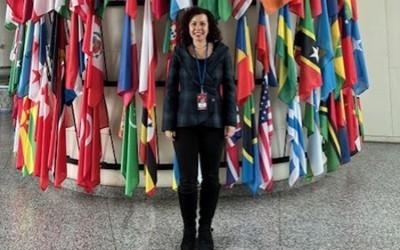
Dr Alessandra Marino (Senior Lecturer, Geography and Environmental Studies and core member of AstrobiologyOU) has joined the United Kingdom delegation to the United Nations Committee on the Peaceful Uses of Outer Space (COPUOS), contributing to international discussions on the governance and sustainability of outer space activities. As part of the UK delegation, Dr Marino delivered two presentations addressing pressing issues of science, policy, and international cooperation in Vienna, Austria, 14 - 16 April 2026.
One of Dr Marino’s contributions was a technical presentation entitled Science Preservation: Considerations for the Moon We Share. The presentation highlighted the unprecedented increase in planned lunar missions over the coming decade and examined the opportunities and risks this expansion presents for scientific research. It emphasised that the Moon’s diverse and interconnected environments — including permanently shadowed regions and polar craters that may contain water ice and unique records of early Solar System history — are both scientifically invaluable and increasingly sought after for exploration and potential resource use.
Drawing on governance experiences from other areas beyond national jurisdiction, including protected areas in Antarctica, Dr Marino highlighted that cooperative approaches to environmental protection and science preservation are both achievable and effective when implemented collectively.
In addition to her technical presentation, Dr Marino delivered a second talk at a side event entitled: Science Preservation on the Moon: Balancing Scientific Value, Access, and Responsible Conduct. Its aim was to contribute to emerging discussions on the importance of international cooperation, scientific stewardship, and long-term responsibility in relation to lunar activities. The talk also delved deeper into learning from Earthly analogues.
Dr Marino noted the importance of supporting evidence-based policymaking within COPUOS and to ensuring that space activities continue to serve scientific, cultural, and intergenerational interests. Acting now, she noted, is essential to preserve the Moon as a shared environment for the benefit of all states and generations to come.
Dr Marino is PI of the project MoonRISE: Reimagining Space Environments, which looks at discussing practical and theoretical implications of designating sites of scientific, environmental and cultural interest on the Moon.
Contact our news team
For all out of hours enquiries, please telephone +44 (0)7901 515891
Contact detailsNews & articles

£309k funding to explore how AI can identify breakthrough science
Dr Angelo Salatino, from the Open University's Knowledge Media Institute , has secured £308,702 (£186,028 to the OU) in funding from UK Research and Innovation (UKRI) for a project that aims to identify potentially transformative research earlier and more effectively.


Explore

Undergraduate
Postgraduate
Policy
-
Follow us on Social media
-