Research image of month: A window into ‘hellish’ art and social order
This month’s research image of the month (October 2025) captures Dr Angeliki Lymberopoulou’s research, which explores how Byzantine paintings and icons reveal cultural exchange, social identity, and religious ‘policing’.
In Angeliki’s own words…
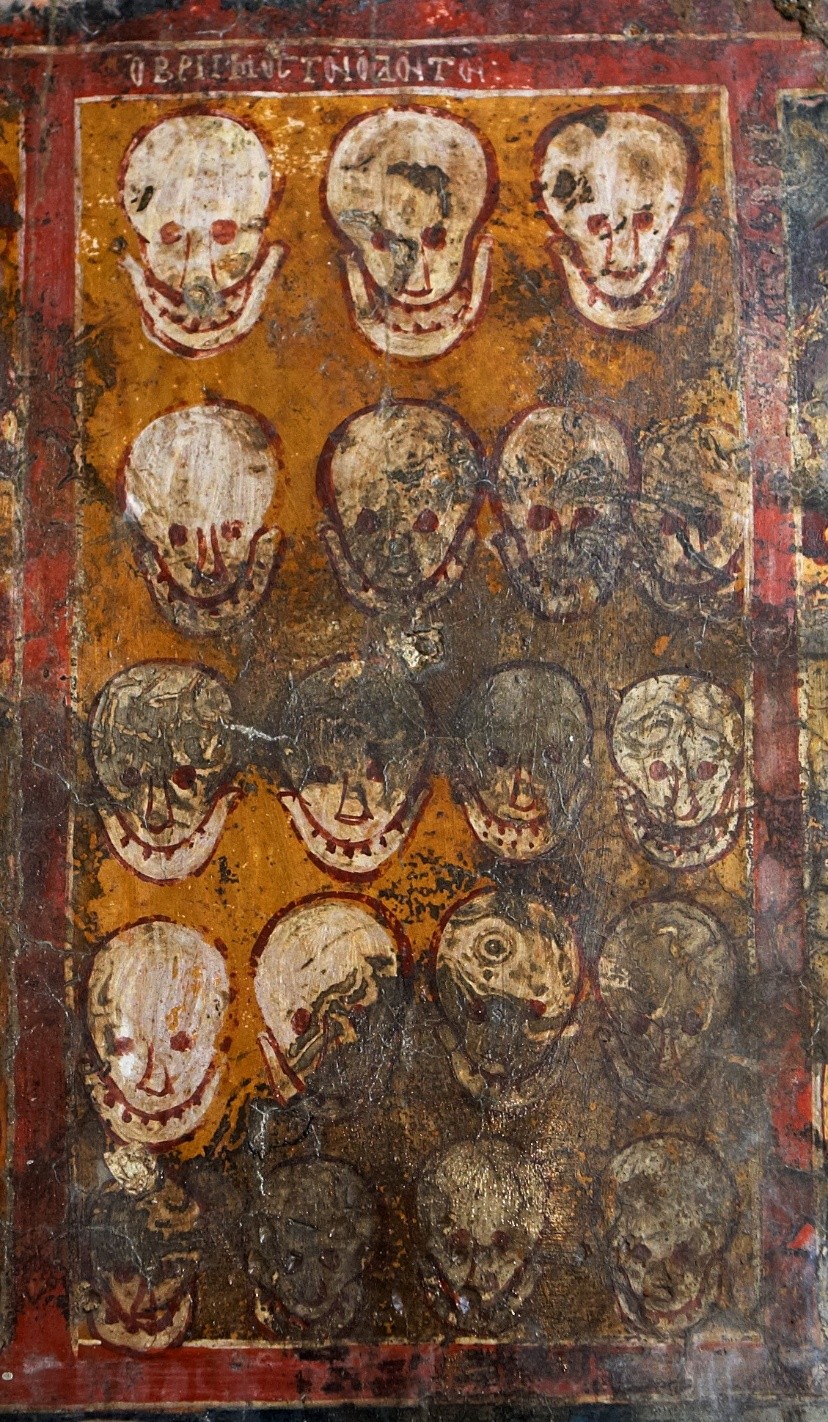
When I first encountered the image, now selected as the Open University’s Research Image of the Month for October, I was struck by its eerie power. It depicts rows of skulls with exaggerated jaws and prominent teeth, an unsettling visual representation of the biblical phrase “gnashing of the teeth.” This image, found in a rural Byzantine church dated 1303 in rural north-west Crete, is not just a haunting portrayal of hell; it’s a profound reflection of how medieval societies used art to communicate moral codes and social boundaries – something that art and imagery still does today.
My research, funded by the Leverhulme Trust, explores representations of hell across the Byzantine world, with a particular focus on Venetian Crete, my area of expertise and my homeland. Crete, under Venetian rule from 1211 to 1669, offers a rich tapestry of cross-cultural interaction between the native Greek Orthodox population and the Roman Catholic colonists. In rural areas, Byzantine culture remained dominant, and over 100 churches have been identified with vivid depictions of hell. These images served as moral deterrents, reinforcing Christian doctrine and guiding behaviour through fear of eternal punishment.
The image I chose is powerful because it captures an acoustic punishment – the sound of teeth gnashing endlessly – through visual means. Described in scripture as a torment of the damned, the phenomenon is represented by skulls with gaping jaws, evoking the eerie grinding noise in a dark, foul-smelling abyss. The Byzantine artist had no precedent for depicting sound, yet their imaginative approach resonates even today. It’s uncomfortable to look at, and that discomfort is precisely the point. It’s a visual warning, a social “wagging finger” reminding viewers to live virtuously or suffer the consequences.
My academic journey began with a BA in archaeology and art history, initially focused on ancient Greek sculpture. But a required course in Byzantine art changed everything for me as I fell in love with the subject and pursued postgraduate studies in medieval art and architecture, culminating in a PhD in Byzantine art. That unexpected module taught me the value of openness to new ideas, a principle that aligns beautifully with the Open University’s mission to be open to people, places, and ideas.
This image also speaks to the broader impact of my research. By examining how medieval societies used art to police behaviour, we gain insight into the enduring power of imagery. Today, we still use visual deterrents… think of graphic warnings on cigarette packets or climate crisis imagery that are designed to influence and deter behaviours of publics. Art evolves with society, adapting to new contexts while retaining its communicative force.
Being selected as Research Image of the Month is deeply meaningful to me. It’s a recognition not only of my work but of Byzantine art itself, which is often overlooked in mainstream art history. The Open University’s willingness to platform such research reflects its commitment to inclusivity and intellectual diversity. I feel honoured and proud to be part of an institution that values all voices and perspectives, giving space to art that challenges, educates, and resonates across time.
Contact our news team
For all out of hours enquiries, please telephone +44 (0)7901 515891
Contact detailsNews & articles
OU public health campaign shortlisted for national Carers UK Award
A national public health campaign co-developed by The Open University researchers to support UK-wide communities to age well, inclusive of, co-developed with and for unpaid carers, has been shortlisted for the ‘Standout Campaign of the Year’ category at the 2026 Carers UK Awards.


Explore

Undergraduate
Postgraduate
Policy
-
Follow us on Social media
-