OU academics reveal the hidden information in icy moon surface salts
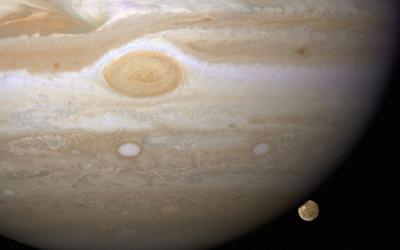
Researchers from The Open University (OU), working with colleagues from University College London and Diamond Light Source, have revealed in a new paper how seemingly simple salts on the surface of the Solar System’s icy moons can provide important clues about their interior workings.
This new paper, led by OU researcher Dr Rachael Hamp, follows on from the team’s recent discovery of a new type of salt crystal, made of sodium chloride (table salt) and water molecules, which forms at extremely low temperatures relevant to icy moons such as Europa (Jupiter) and Enceladus (Saturn). These icy moons may contain suitable conditions for life, and sodium chloride is a key ingredient of their interior oceans. When subjected to extremely low temperatures, these familiar materials combine in unfamiliar ways, forming unique very cold-stable crystals.
In this latest study, Dr Hamp and the team mimicked the extreme cold of icy moon surfaces to study how sodium chloride dissolved in water might behave on these worlds. They revealed that different salt minerals, including the newly discovered salt crystal and several others like it, are produced at different freezing rates. This phenomenon means that the presence of certain salts on icy moons would act as a ‘record’ for specific freezing conditions. In other words, the salts on icy moons contain information about how they formed and the internal workings of these icy worlds.
Dr Hamp, lead author of the new study, says: “It's amazing that everyday materials we're so familiar with can transform in unexpected ways, creating entirely new minerals when exposed to these very cold temperatures.”
Understanding how salts on icy moons formed is a vital step in searching for evidence of life. Although the oceans are locked beneath many kilometres of ice, ocean water may periodically break through the ice to the surface where it can be studied by spacecraft for signs of life below. But until now, we’ve had no way of locating where this may have happened, or – just as importantly – what conditions ocean chemicals may have experienced as they travel upwards to the surface.
The new study also shows how the salts could be detected by spacecraft such ESA’s JUpiter ICy moons Explorer (JUICE) and NASA’s Europa Clipper using remote infrared cameras. Just how geologists on Earth use rocks and minerals to understand what happened deep beneath the surface of our planet, upcoming missions like these will be able to do ‘cryo-geology’ in order to understand processes going on beneath the surfaces of icy moons.
Through this work, Dr Hamp and team have provided the first tool for understanding the geological history of the surfaces of icy moons.
Dr Hamp added: “If upcoming missions identify sodium chloride minerals on the surface of these icy moons, we'll gain a much deeper understanding of what's happening beneath their icy surfaces.”
Contact our news team
For all out of hours enquiries, please telephone +44 (0)7901 515891
Contact detailsNews & articles

OU secures major grants to strengthen trust in AI
A researcher from The Open University's Knowledge Media Institute has secured a major UK Research and Innovation grant to help ensure artificial intelligence can be used safely, fairly and transparently in research assessment.


Explore

Undergraduate
Postgraduate
Policy
-
Follow us on Social media
-