New research in geometry and number theory
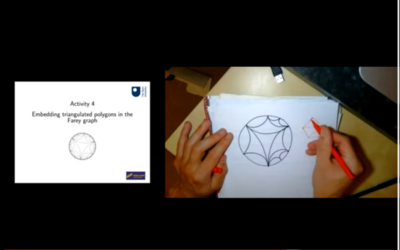
An OU academic has received almost £370,000 from the Engineering and Physical Sciences Research Council to conduct research into geometry and number theory.
Led by Dr Ian Short, Director of Research in Mathematics in the OU’s Faculty of Science, Engineering, Technology and Mathematics, who is Principal Investigator, the project will bring together a significant body of work in the field of SL2-tilings, which are types of number patterns.
SL2-tilings have attracted significant interest recently because of their relationships with multiple mathematical fields. Developed between July 2022 and June 2025, the research models will provide algebraic and geometric insight into SL2-tilings and will unify a host of other works in the subject.
The research will build on previous work from Dr Short in his paper Classifying SL2-tilings and will strengthen the UK's world-leading profile in this rapidly expanding field.
It will also provide a basis for outreach to wider audiences.
Dr Short said: “We will develop a framework to classify SL2-tilings using the geometry of the hyperbolic plane (an alternative to the usual flat plane in which there is more space). The research will be shared widely through the Navigating by numbers outreach programme."
The project will involve collaboration with Professor Peter Jørgensen, Danish National Research Foundation Chair Professor, Aarhus University, Denmark.
Find out more about OU research in the OU’s Dynamical Systems Group
Contact our news team
For all out of hours enquiries, please telephone +44 (0)7901 515891
Contact detailsNews & articles
Can care build a better economy?
The Open University hosted its third lecture in its Global Development Annual Lecture series on 22 October 2026, delivered by Naila Kabeer, Professor Emeritus at the London School of Economics, a faculty member of their International Inequalities Institute, and on the government board of the Atlantic Fellowship for Social and Economic Equity.


Explore

Undergraduate
Postgraduate
Policy
-
Follow us on Social media
-