At UNESCO: Rethinking researcher development for a sustainable future
A river drought researcher cannot solve complex environmental challenges through science alone. A health researcher cannot address vaccine hesitancy using epidemiology in isolation. Today's most urgent problems — climate change, inequality, digital disruption — demand researchers who collaborate across cultures, think ethically about impact, and translate knowledge into action. Yet traditional training rarely develops these critical skills.
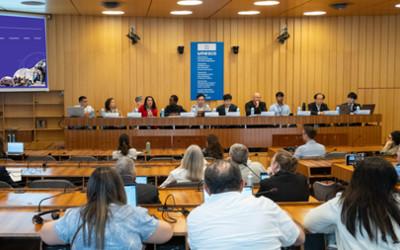
At UNESCO's Digital Learning Week (2 - 5 September 2025), Dr Alexandra Okada, Associate Professor in Global Education and Digital Transformation at The Open University, introduced upSkill.Map, a self-assessment framework helping researchers develop beyond disciplinary boundaries. Rather than ticking off competencies, it asks deeper questions: What do I care about? What knowledge am I building? How do I drive meaningful change?
The upskill framework operates through three interconnected dimensions:
- CARE: Values, ethics, and responsibility—understanding research's social and environmental impact through communication, collaboration, and cultivation skills.
- KNOW: Critical thinking, interdisciplinary awareness, and digital literacy strengthened by construction, comprehension, and cocreation.
- DO: Decision-making and action that drives change and strengthens the common good through coordination and catalysis.
Pilot studies with doctoral researchers reveal encouraging commitment to collaboration and responsibility — researchers genuinely want their work to matter. Yet results expose institutional shortfalls: limited support for interdisciplinary collaboration and struggles connecting work to broader societal challenges.
The message is clear: researchers are ready to engage complexity. They need structured support to do it.
Developed through the European Commission-funded METEOR project, upSkill.Map offers two critical contributions:
- For doctoral education: A practical framework for developing transversal competencies alongside technical expertise.
- For institutional culture: Partnership with international collaborators building new models of professional learning grounded in sustainability, justice, and responsible innovation.
As Dr Okada emphasizes: "Research isn't only about advancing knowledge, it's about consolidating innovation with the future we want to create."
By embedding sustainability and justice in researcher development, and supporting critical engagement with emerging technologies, upSkill.Map equips doctoral researchers to become adaptive, collaborative, ethically grounded professionals ready to transform knowledge into meaningful change.
Links presented at UNESCO Digital Learning week: AI and the Future of Education
- Okada, A. & Vaz, G. (2025). Rethinking AI in Research with Ancestral Wisdom for Future Generations. UNESCO – Futures of Education
- Okada, A; Sherborne, T; Panselinas, G; Kolionis, G (2025). Fostering Transversal Skills through Open Schooling supported by the CARE-KNOW-DO Pedagogical Model and the UNESCO AI Competencies Framework. International Journal of Artificial Intelligence in Education. Springer
- Okada, Alexandra (2025). Knowledge Cartography for Young Thinkers: Sustainability Issues, Mapping Techniques and AI Tools. Advanced Information and Knowledge Processing. Funded by European Commission and supporting UNESCO. Switzerland: Springer
Contact our news team
For all out of hours enquiries, please telephone +44 (0)7901 515891
Contact detailsNews & articles
OU public health campaign shortlisted for national Carers UK Award
A national public health campaign co-developed by The Open University researchers to support UK-wide communities to age well, inclusive of, co-developed with and for unpaid carers, has been shortlisted for the ‘Standout Campaign of the Year’ category at the 2026 Carers UK Awards.


Explore

Undergraduate
Postgraduate
Policy
-
Follow us on Social media
-