Day 57, Year of #Mygration: Gender, Skilled Migration & IT industry, a study of India & the UK
The global IT sector is characterised by low participation of women, with the UK being no exception. Many attempts have been made to address the problem of small and falling numbers of women in IT education, training and employment because narrowing the gender gap in high productivity sectors like IT will add 150 billion GBP to the UK GDP forecast for 2025. However, these attempts have had little success.
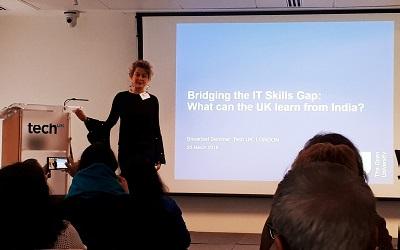
A new report was launched this morning, publishing the findings of an OU-led, ESRC-funded project - Gender, Skilled Migration and IT industry: a comparative study of India and the UK. The project has been comparing the profiles of the IT industry in UK with that in India. It considered why the IT sector in India, in contrast to many places including the UK, manages to attract such a high proportion of women in highly-skilled roles. It also gained insights from migrant women and men who move between the two countries, and have experience of both cultures, to understand both the gender norms and the best practice in each country.
The OU project was led by Professor of Geography and Migration Parvati Raghuram, with co-investigator Dr Clem Herman, Senior Lecturer in Computing and Communications, and Research Associates Dr. Gunjan Sondhi and Dr. Esther Ruiz Ben. The project partners included the BCS, TechLondon Advocates, techUK and NASSCOM.
The report highlights that the Indian IT sector:
- has achieved comparative advantage to other sectors by offering career support; high status, reward and security; and visible equality policies that attract women;
- effectively recruits into the sector through targeted high profile campaigns and campus recruitment; 50% of the companies recruit directly through universities providing a safe pipeline from study to work;
- enables career progression as 50% of the companies offer in-house leadership and management programmes; This has contributed to 30% of companies doubling the proportion of senior women between 2012 and 2017;
- invests in skills development to retain staff and keep a competitive edge.
Contact our news team
For all out of hours enquiries, please telephone +44 (0)7901 515891
Contact detailsNews & articles

OU public health campaign shortlisted for national Carers UK Award
A national public health campaign co-developed by The Open University researchers to support UK-wide communities to age well, inclusive of, co-developed with and for unpaid carers, has been shortlisted for the ‘Standout Campaign of the Year’ category at the 2026 Carers UK Awards.


Explore

Undergraduate
Postgraduate
Policy
-
Follow us on Social media
-