AI sheds new light on dinosaur footprints
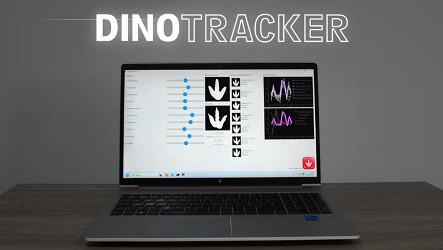
A new publication introduces a transformative AI approach to studying dinosaur footprints, offering researchers (and enthusiasts!) an objective way to classify tracks and investigate the conditions in which dinosaurs lived.
The paper, published in Proceedings of the National Academy of Sciences (PNAS), discussed how using an unsupervised neural network, the team — including Dr Gregor Hartmann of Helmholtz-Zentrum Belrin and Open University (OU) Researcher Tone Blakesley — analysed nearly 2,000 fossil footprints and identified eight key shape features, such as digit spread, heel position and load distribution, to identify the variation in footprint shape.
Tone’s involvement in the project began years earlier on the Isle of Skye. Summers spent fossil hunting with local expert and colleague Dr Dugie Ross sparked his passion, leading to the discovery of his first footprint in 2018 and undertaking his Masters at the University of Edinburgh – supervised by Professor Steve Brusatte and Dr Paige dePolo. This journey laid the foundation for DinoTracker, a free user friendly app built from footprint research.
The study focuses on two debated sets of footprints, each highlighting the app’s ability not just to classify tracks but to interrogate environmental conditions.
The Late Triassic “bird like” tracks – found in South Africa- are 215 million year old footprints that closely resemble modern bird tracks, despite predating bird fossils by some 60 million years. DinoTracker confirmed their strong similarity to both fossil and living bird prints. This finding raises the questions: were these shapes the result of anatomy, or did dinosaurs walking on wet, unstable ground splay their toes for stability? The app’s feature sliders allow researchers to consider how substrate and behaviour may have produced these bird like impressions.
An additional set of Middle Jurassic footprints on the Isle of Skye suspected to belong to ornithopods were identified using DinoTracker – supporting the clades more ancient origins compared to evidence provided by body fossils. This prompts new questions about how herbivorous and carnivorous dinosaurs shared coastal habitats, and how different substrates influenced footprint preservation.
The DinoTracker app allows users to upload or draw footprints, explore morphological features and compare results across a set of seven closest footprint ‘neighbours’, providing a powerful way to study behaviour, movement and ancient landscapes. As an article about the app in The Conversation notes, footprints reflect not just anatomy but ground conditions, and AI now helps reveal those hidden stories.
With future expansions and potential citizen science applications, DinoTracker embodies the OU’s mission to make cutting edge research open, accessible and deeply engaging.
You can find out more information about DinoTracker in this short video created by and featuring Tone Blakesley.
Hey everyone, it's Tone here and today I'm really excited to be telling you about a project that's really close to my heart. A three-year collaboration with colleagues from Helmhold Center in Berlin, the University of Edinburgh, and Liverpool John Mo University on an engaging machine learning powered app. a virtual assistant that we hope will help researchers and students better understand dinosaur footprints. And it's all to do with their shape.
Introducing DinoTracker.
Okay, so what is DinoTracker exactly?
DinoTracker is a powerful thinking tool that allows you to recognize the variation in shape of your very own dinosaur footprints and to test out specific hypotheses from identifying track makers to thinking about the environments that they once traversed.
Dinosaur footprints, I think, are some of the most fascinating, even the most iconic fossils, but they can be challenging to study because when you see a dinosaur footprint, the shape of that footprint is based on many different things. It's determined by the foot of the dinosaur, by the type of sand or mud that the dinosaur is walking through, and by the motion of the foot.
Using DinoTracker, this has helped us to understand the variation among nearly 2,000 dinosaur footprints. And that helps us have a more informed view of whether certain footprints were made by meati-eating dinosaurs or duck build dinosaurs. Or probably in the most troublesome case, there are tracks that are well more than 200 million years old, three toes, look a lot like the footprints of birds today. But if they are bird tracks, they would be many tens of millions of years older than any bird skeleton fossil. And that's why we need tools, better tools to understand the variation of dinosaur footprints.
I would say it's always super cool to have this interdisciplinary talk to each other effectively because all the involved persons were so nice to each other. It was really just fun, I would say. So the idea behind this is that we have the silhouettes of the footprints uh drawn by paleontologists and these images consist of thousands of pixels. So in images are high dimensional and what this disentangled variational autoenccoder tries to achieve is to really find find out what is varying independently in this tracks to find so to say the underlying core principle that created that footprint.
And for our application this core principle um is only eight dimensional, meaning only eight features are needed to describe these tracks, something like overall load or digit attachment. This is what is varying in that footprint and from this lower dimensional eight-dimensional space it then reconstructs the input footprint again. And based on these eight features, we can then compare and interpret each and every individual footprint.
So each of these eight features are in turn manipulable within Dino Tracker itself. These as you can see plot really nicely real time onto our exportable graphs opposite showcasing our footprint alongside a top result of seven further footprints from our data set with similar features.
But there is something else that we can do.
What we still need is a is an easy access visualization of all these 2,000 tracks that we have in our data pool. So you put in a new track and you want to see where is its neighbours, what is it close to? And TSN is a very popular technique from data science. And compared to other traditional methods, it tries to map this eight-dimensional space to a two-dimensional map. So to somehow roughly keep the distances in that eight-dimensional space on this two-dimensional space. Um, of course, it's not entirely possible, but it tries it as good as possible. And if you do this, you get that JS and E map which is available in Dino Tracker. And there you can just pull in your nuke footprint which you're currently analysing and it places this on a map alongside all of our data pool. So you can easily see if it's close to a theropot, a bird or an onto pot um or a tetropot.
For instance, when we look at some of these footprints that were made uh by some kind of dinosaur back in the triacic period, they look a lot like bird tracks. We see that actually the neural network model in the Dino Tracker app it it shows that they are most similar to bird tracks. It doesn't mean that they were necessarily made by birds but it means that yes what human researchers have recognized with their eyes as paleontologists when we look at these tracks and they look similar to birds that is true. The computer finds it as well. So either these tracks were made by birds that were tens of millions of years older than the previously oldest fossils or by dinosaurs that really really really back in the triacic period had feet that were similar to the feet of birds today or walked or moved in similar ways to birds today.
In another case, we use DinoTracker to look at some tracks from the Isle of Skye from here in Scotland where I work. tracks that that my team has studied and described over the years.
These tracks were made about 170 million years ago back in the Jurassic period. They are fairly large, about the size of a dinner plate, even a bit bigger, and they have three big toes.
Were they made by meat-eating dinosaurs? Were they made by duck build dinosaurs? If they were made by duck build dinosaurs, they would be perhaps the oldest members of that iconic group in the fossil record. DinoTracker tells us that some of these tracks from the Isle of Skye really are very similar to the tracks of known duck build dinosaurs. So we think it's very likely that some of these were made by pioneering duck build dinosaur species.
As a young researcher, I'm really grateful to my colleagues Steve Paige and of course lead app developer Gregor for giving me this opportunity to work on Dino Tracker, this innovative thinking tool that I hope you'll be able to draw on to better understand the variables that affect the shape of both dinosaur and bird footprints through feature comparison.
And the exciting thing about DinoTracker is that we're going to be continuing to develop it, adding more features that will allow you to make even better assertions on the footprints that you input into it. You can find D tracker on GitHub via the link in the description below. And if you have any thoughts or suggestions, we'd be very interested to hear them from you.
And yeah, thank you so much for watching.
I hope that you enjoy using DinoTracker as much as we did making it. And hopefully I'll see you in the next video.
Contact our news team
For all out of hours enquiries, please telephone +44 (0)7901 515891
Contact detailsNews & articles

OU public health campaign shortlisted for national Carers UK Award
A national public health campaign co-developed by The Open University researchers to support UK-wide communities to age well, inclusive of, co-developed with and for unpaid carers, has been shortlisted for the ‘Standout Campaign of the Year’ category at the 2026 Carers UK Awards.


Explore

Undergraduate
Postgraduate
Policy
-
Follow us on Social media
-