Eradicating poverty without growth: can it be done?
- Dates
- Thursday, November 20, 2025 - 16:00 to 17:00
-
Location
- Berrill Lecture Theatre, Walton Hall, The Open University, MK6 7AA
The Open University is a longstanding hub for interdisciplinary, critical, and forward-looking research on international development. Celebrating its work and engaging with current debates, the University launched the OU Global Development Annual Lecture series in 2024.
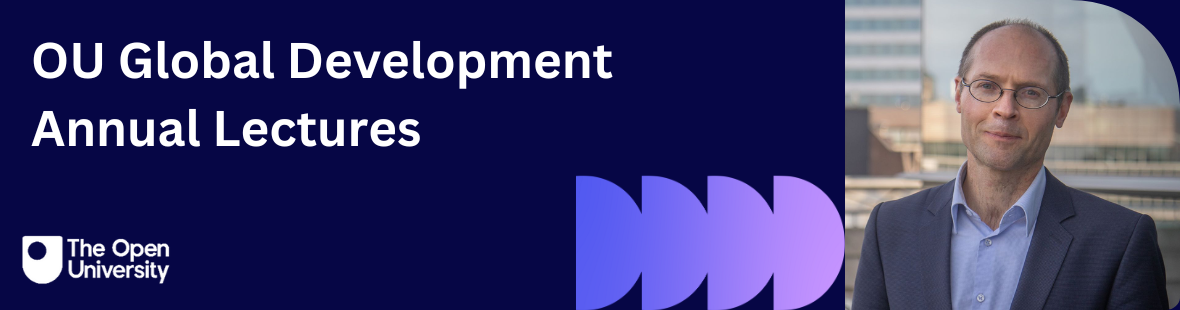
In the second annual lecture in the series, Olivier De Schutter, United Nations (UN) Special Rapporteur on extreme poverty and human rights will address the theme: Eradicating poverty without growth: can it be done?
Professor De Schutter, expert on social and economic rights and on economic globalization and human rights, will present an alternative roadmap to current and previous approaches to the theme and put out a call for action rather than optimism.
Kavita Ramdas, a globally recognised advocate for gender equity and justice, will offer reflections before the floor is opened for in-person and online engagement.
Abstract
Defined as the increase of gross domestic product (GDP), economic growth has long been seen as desirable in itself. Economists have debated how it can be achieved, and politicians how its benefits could be shared. Human rights bodies have seen growth as an indispensable condition for the realization of economic and social rights, based on the assumption that without growth, there would be no resources to mobilize for the progressive realization of such rights – for investments to be made in the provision of healthcare, social housing or education, or for the creation of jobs.
Today however, as environmental breakdown, inequality, and economic precarity deepen, the promise that economic growth alone can end poverty has collapsed.
In this lecture, the UN Special Rapporteur presents a bold alternative: the Roadmap for Eradicating Poverty Beyond Growth. This UN-backed initiative lays out a rights-based, post-growth strategy to make poverty eradication a deliberate outcome of restructured economies - not a trickle-down side effect of aggregate expansion.
Developed through wide-ranging global consultations, the Roadmap offers a practical catalogue of transformative policies. These span universal social protection, care-centered labour systems, progressive fiscal reforms, global debt justice, and democratic governance of natural resources. It redefines progress around dignity, equity, and planetary boundaries across income levels and governance contexts, proposing context-specific pathways for justice in both the Global North and Global South.
In a time of cascading crises, this lecture is not a call for optimism, but a call for action - through visionary leadership, collective courage, and policies that serve both people and planet. As governments and international institutions begin shaping the next generation of global development goals, the Roadmap provides direction for a historic shift away from the false inevitabilities of growthism, and toward economies grounded in the effective realisation of human rights, well-being, and ecological responsibility.
Olivier De Schutter
Professor, UCLouvain and SciencesPo (Paris)
Special Rapporteur on extreme poverty and human rights (from 1 May 2020)
Member of the UN Committee on Economic, Social and Cultural Rights (2015-2020)
Special Rapporteur on the right to food (2008-2014)
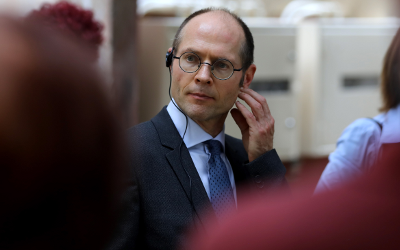
Mr De Schutter was appointed the UN Special Rapporteur on extreme poverty and human rights in March 2020. A Professor of Law at UCLouvain and at SciencesPo (Paris), Mr De Schutter is also a member of the Global Law School Faculty at New York University. He holds a LL.M. from Harvard University, a diploma cum laude from the International Institute of Human Rights (Strasbourg) and a Ph.D. in Law from UCLouvain. He has taught human rights at the University of Leicester (United Kingdom), at the College of Europe (2008-2016), at Columbia University (2008-2013) and Yale University (2016-2017). He was a visiting professor at UC Berkeley in 2013-2014, where he helped launch the Berkeley Food Institute. In 2013, he was awarded the prestigious Francqui Prize for his contribution to international human rights law and to the theory of governance.
An expert on social and economic rights and on economic globalization and human rights, Mr De Schutter served between 2004 and 2008 as a Secretary General of the International Federation for Human Rights (FIDH). He was then appointed the United Nations Special Rapporteur on the Right to Food, a mandate which he fulfilled between 2008 and 2014. He was elected a Member of the United Nations Committee on Economic, Social and Cultural Rights in 2015, and resigned from that position in May 2020 in order to accept the mandate of Special Rapporteur on extreme poverty and human rights.
Mr De Schutter has published widely on economic and social rights and on the relationship between human rights and development. His most recent books in this area The Poverty of Growth (Pluto Press, 2024), Social Innovation in the Service of Ecological and Social Transformation. The Rise of the Enabling State (Routledge, 2021), International Human Rights Law (Cambridge University Press, 3rd ed. 2019), Property from Below. Commodification of Land and the Counter-Movement (Routledge, 2020) (co-editor), Governing Access to Essential Resources (Columbia Univ. Press, 2016) (co-editor), Trade in the Service of Sustainable Development (Bloomsbury/Hart, 2015), Economic, Social and Cultural Rights as Human Rights (Edward Elgar, 2013), Accounting for Hunger. The right to food in the era of globalization (Hart, 2011) and Foreign Direct Investment and Human Development. The Law and Economics of International Investment Agreements (Routledge, 2012). He was one of the lead authors of the Maastricht Principles on Extraterritorial Obligations of States in the area of Economic, Social and Cultural Rights, adopted in September 2011 by a large number of human rights experts and civil society groups (see 'Commentary to the Maastricht Principles on Extraterritorial Obligations of States in the area of Economic, Social and Cultural Rights', Human Rights Quarterly, vol. 34 (2012), pp. 1084-1171).
Mr De Schutter has also published extensively on transnational corporations and human rights. An advocate of a new international treaty on that issue (‘Sovereignty-plus in the Era of Interdependence : Towards an International Convention on Combating Human Rights Violations by Transnational Corporations’, in Making Transnational Law work in the Global Economy: Essays in Honour of Detlev Vagts, P. Bekker, R. Dolzer and M. Waibel (eds), Cambridge University Press, 2010, pp. 245-284; ‘Rapport général - La responsabilité des Etats dans le contrôle des sociétés transnationales: vers une Convention internationale sur la lutte contre les atteintes aux droits de l’homme commises par les sociétés transnationales’, in La responsabilité des entreprises multinationales en matière de droits de l’homme, Bruxelles, Bruylant-Némésis, 2010, pp. 19-100), he took an active part, as an independent expert, in the work of the Open-Ended Intergovernmental Working Group on a new legally binding instrument on transnational corporations and other business enterprises with respect to human rights.
A long-standing advocate of the right to development, Mr De Schutter is the author of the report The international dimensions of the right to development: a fresh start towards improving accountability, prepared at the request of the United Nations Working Group on the Right to Development (UN doc. A/HRC/WG.2/19/CRP.1) (March 2018). He also presented the study The Rights-based Welfare State. Public budgets and human rights (Friedrich-Ebert Stiftung, Geneva, 2018), on the alignment of public budgets and fiscal reforms on the requirements of human rights At the request of the Asian Development Bank, he prepared a report on gender empowerment and food security, in which he examines in detail how social protection can be turned into a tool to improve the situation of women, as well as the role of microfinance.
Among his most widely cited articles are his studies on the impact of austerity policies in Europe ("The Two Constitutions of Europe: Integrating Social Rights in the New Economic Architecture of the Union" (with Paul Dermine), European Journal of Human Rights, n° 2 (2017), pp. 108-156), on the "activation" of welfare ("Welfare State Reform and Social Rights", Netherlands Quarterly of Human Rights, vol. 33(2) (2015), pp. 123-162), on the impacts of tax reform on economic and social rights ("La fiscalité au service de la réalisation des droits économiques, sociaux et culturels", Revue trimestrielle des droits de l'homme, n°115 (2018), pp. 547-582), on land grabs ('The Green Rush: The Race for Farmland and the Rights of Land Users", Harvard International Law Journal, vol. 52(2) (2011), pp. 503-559), and on intellectual property rights on plant varieties (‘The right of everyone to enjoy the benefits of scientific progress and the right to food : from conflict to complementarity’, Human Rights Quarterly, vol. 33 (2011), pp. 304-350).
Mr De Schutter has contributed actively to the strengthening of the protection of fundamental rights in the European Union, as well as to the debate on the relationship between the EU and the Council of Europe. Between 2002 and 2007, he was the coordinator of the EU Network of Independent Experts on Fundamental Rights, a high-level group of experts from the then EU-25 Member States that provided advice to the European Commission and the European Parliament (LIBE Committee) on fundamental rights protection in the European Union. He also served as a member of the Scientific Committee of the Fundamental Rights Agency of the European Union (2013-2018). He authored several expert reports for the Council of Europe and for the European Union, concerning, inter alia, the role of the European Social Charter in the EU legal order and the contribution of the European Pillar of Social Rights, in which he provides suggestions for improving the recognition of social rights in European integration.
Mr De Schutter is, inter alia, the co-founder and former general secretary of the Journal de droit européen, member of the Scientific Committees of the Revue belge de droit international, the Nordic Journal of Human Rights and the Netherlands Quarterly of Human Rights, and he was formerly a member of the Scientific Committee of the journal Droit en Quart Monde. He is also the founder and Editor-in-chief of the European Journal of Human Rights/Journal européen des droits de l'homme.
Attendance
Watch the webinar online
Please take the opportunity to have your questions answered by our speakers LIVE during the event:
Email us your questions Use #OUtalks on X
Event programme
| Timings | Item |
|---|---|
| 15:30 | Registration opens |
| 16:00 | Lecture by Professor Olivier De Schutter |
| 16:40 | Reflections by Kavita Ramdas |
| 16:45 | Q&A |
| 17:00 | Networking over refreshments |


Explore

Undergraduate
Postgraduate
Policy
-
Follow us on Social media
-